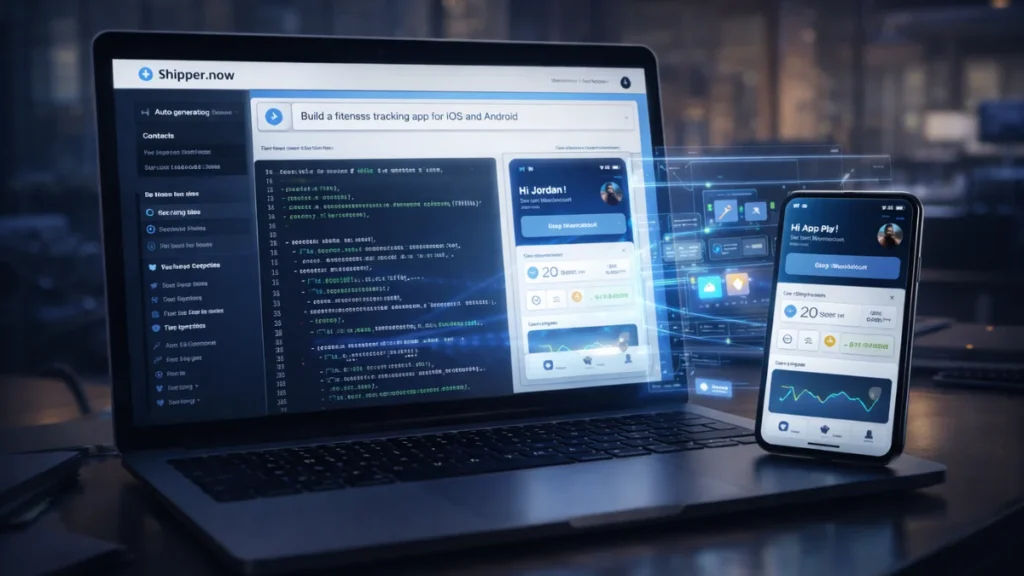
A week after Anthropic rolled out a major upgrade to its flagship AI model, a small startup says it has already turned that breakthrough into a consumer product. Shipper.now claims users can now chat with Claude Opus 4.6 and generate complete native mobile apps—ready for submission to Apple and Google’s app stores—for roughly 17 cents in AI costs.
If the demos hold up under scrutiny, the implications for software development could be significant.
A New Layer on Top of Claude
On February 11, Shipper.now co-founder Daniel Ch announced that his platform now integrates Claude Opus 4.6, the latest model from Anthropic. The promise is straightforward: describe an app in plain English, and the system generates the code, interface previews, screenshots, privacy policy text, and even QR codes linking to store listings.
Shipper positions itself as a workflow layer rather than a model innovator. Claude does the heavy technical lifting; Shipper wraps it in a publishing pipeline aimed at non-technical founders.
The pricing is equally aggressive. A Pro plan costs $25 per month, and Ch says a typical app build consumes about $0.17 in AI inference fees. That figure, if accurate, undercuts traditional development costs by orders of magnitude.
The pitch is simple: you don’t need a development team. You need a prompt.
🚨 INTRODUCING: @claudeai just got a huge upgrade today
— Daniel Ch (@chddaniel) February 11, 2026
Claude Opus 4.6 can now build iOS/Android apps
And help you PUBLISH them on the iOS/Apple + Google/Play app stores
We just launched Shipper as a way to empower Claude to:
✅ Build complete mobile apps
✅ Recreate existing… pic.twitter.com/UHJlqYin5g
Why This Moment Matters
AI-generated code is not new. Developers have used tools like GitHub Copilot and other large language models to assist with programming for years. What’s different now is scope and accessibility.
Claude Opus 4.6 appears capable of generating not just code snippets, but cohesive mobile applications—complete with front-end interfaces, backend logic, and documentation. The timing is notable. Generative AI has been steadily improving in reasoning, long-context processing, and structured output reliability. Those capabilities are essential for building production-ready apps.
Shipper’s announcement effectively asks: if the model can already write the code, why not build a streamlined system that packages everything for publishing?
For solo founders and small teams, that question is compelling.
What the Demos Show
In public demonstrations shared online, Shipper-generated apps include:
- Functional UI screens
- App previews and screenshots
- Privacy policy text
- QR codes for distribution
- Packaging designed for submission to Apple and Google stores
The focus isn’t on toy prototypes. The platform claims to produce native mobile applications suitable for real distribution.
That distinction matters. Generating a working demo on a laptop is one thing. Passing app store review processes is another.
Skepticism: Is This Just Claude?
Not everyone is convinced Shipper represents a meaningful leap.
Some early observers argue that much of what Shipper demonstrates can already be achieved by prompting Claude Opus 4.6 directly. If that’s true, Shipper’s value proposition may hinge less on technological novelty and more on workflow automation and user experience.
There’s also a more practical concern: app store approval.
Both Apple and Google enforce strict review guidelines around privacy, security, data collection, and content moderation. An app that compiles successfully is not necessarily an app that gets approved.
As of now, there are no publicly verified Shipper-generated apps confirmed to be live in major app stores. That gap between demonstration and deployment could prove decisive.
The App Store Gatekeepers
Publishing an app is often more complicated than writing one.
Apple’s App Store review process can take days, sometimes longer if revisions are required. Google’s Play Store is typically faster but still enforces policy checks. Both companies scrutinize privacy disclosures, in-app purchases, subscription handling, and compliance with regional laws.
For non-technical founders—the very audience Shipper targets—navigating these requirements can be daunting.
If Shipper can reliably automate not just code generation but compliance packaging, it may carve out a niche. If not, users may discover that generating an app is the easy part; shipping it is harder.
The Bigger Industry Signal
Zoom out, and this development reflects a broader trend: the commoditization of software creation.
For decades, building mobile apps required skilled engineers, design teams, QA testers, and weeks or months of iteration. Costs routinely climbed into the tens or hundreds of thousands of dollars.
Now, the marginal cost of generating an app—at least at a prototype level—may be measured in cents.
This does not eliminate the need for professional developers. Complex, large-scale systems still demand expertise. But for simpler consumer apps—utilities, productivity tools, niche services—the barrier to entry is collapsing.
That has two likely consequences:
- An explosion of new apps.
- A sharper competition for user attention.
When creation becomes cheap, distribution and differentiation become expensive.
What Insiders Notice
Industry professionals will recognize a subtle but important shift here.
Large language models are increasingly capable of handling structured, multi-file outputs. Building a mobile app isn’t just about writing one function—it requires managing dependencies, organizing architecture, and adhering to platform-specific constraints.
If Claude Opus 4.6 reliably handles that complexity, it signals that AI coding tools are moving from “assistant” to “autonomous builder.”
However, seasoned engineers will also question maintainability. Who debugs the app months later? Who updates it when Apple changes its SDK? How secure is the generated code?
These questions matter far more than the initial build cost.
Why This News Matters
This development affects multiple groups:
Aspiring founders:
Non-technical entrepreneurs could test ideas rapidly without hiring developers upfront.
Small businesses:
Local retailers, creators, or service providers might experiment with custom apps at minimal cost.
Developers:
While not obsolete, developers may see increased pressure to focus on higher-level architecture, optimization, and complex systems.
App stores:
If AI-generated apps proliferate, review systems could face heavier workloads—and potentially more low-quality submissions.
At a societal level, the democratization of software creation lowers barriers but raises new quality-control challenges.
The Economics of $0.17 Apps
The headline figure—17 cents per build in AI fees—demands scrutiny.
Inference costs fluctuate depending on prompt length, iteration cycles, and error corrections. Early builds may be cheap, but debugging and refining could increase usage. Additionally, hosting, backend services, analytics tools, and store fees remain separate costs.
Still, even if the real expense is several dollars per iteration, the economics are radically different from traditional development.
That changes experimentation dynamics. Entrepreneurs can test multiple ideas rapidly, discard failures quickly, and double down on what works.
In venture capital terms, the cost of validation drops dramatically.
The Risk of App Store Saturation
There’s a downside to frictionless creation.
If thousands of AI-generated apps flood app stores, discoverability becomes harder. User trust may erode if quality varies widely. Review systems could tighten requirements, slowing approvals for everyone.
We’ve seen similar patterns in other digital ecosystems: when publishing barriers fall, volume surges, and platforms respond with stricter gatekeeping.
The question isn’t whether AI can generate apps. It’s whether the ecosystem can absorb them.
A Turning Point—or Just a Shortcut?
The real test will be durability.
If Shipper-generated apps pass review, attract users, and operate reliably at scale, this could mark a significant inflection point. If they stall in review queues or require heavy manual correction, the narrative will shift.
Either way, the direction is clear: AI models like Claude Opus 4.6 are rapidly narrowing the gap between idea and implementation.
For years, the hardest part of launching an app was building it. Increasingly, the challenge may be deciding what to build—and how to stand out once you do.