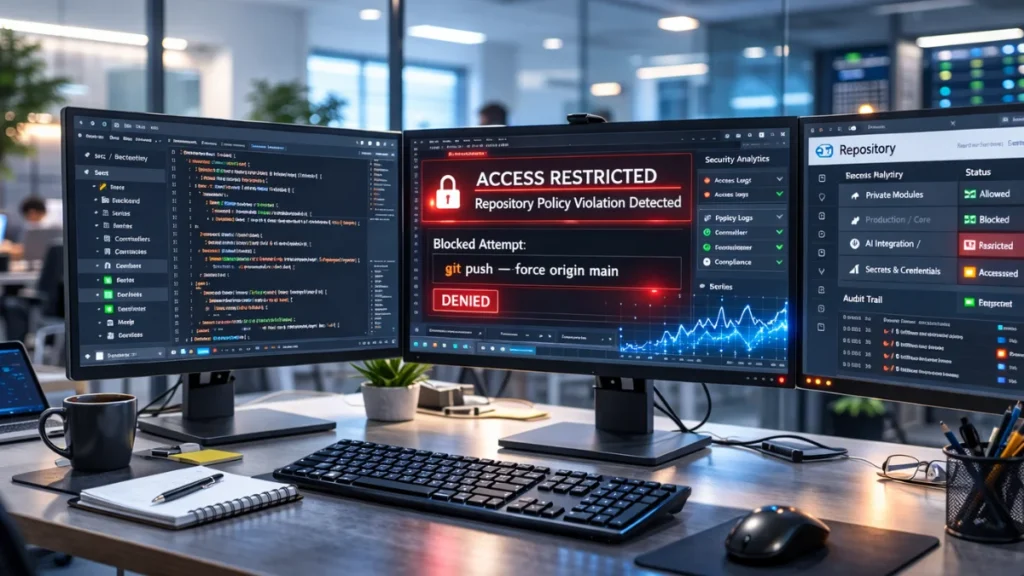
Claude Code Security helps teams use AI to write and review software without exposing sensitive data or introducing hidden vulnerabilities. It matters because AI coding tools can move fast, but one careless integration can leak secrets, break compliance rules, or ship insecure code. This offering focuses on keeping AI-assisted development inside controlled guardrails. The question is not whether AI can write code. It is whether it can do so safely inside real organizations.
Key Summary
- Claude Code Security is designed to let developers use AI for coding while keeping company data and systems protected.
- It focuses on guardrails, permission control, and safer execution rather than just generating code faster.
- Best suited for teams already using Claude in development workflows, especially those with compliance needs.
- Pricing is tied to Anthropic’s enterprise Claude usage rather than a standalone low-cost developer tool.
- Strong in policy control and enterprise positioning, but not a full DevSecOps replacement.
- Workflow value appears when AI interacts with private repos or internal systems, where risk is highest.
What Claude Code Security Actually Does
At a high level, Claude Code Security is not just another AI coding assistant. It is a security layer and governance framework around AI-powered development workflows using Claude.
In plain terms, it helps organizations:
- Control what the AI can access
- Restrict what it can execute
- Prevent sensitive data from leaking
- Enforce policy boundaries around AI-assisted coding
That distinction matters.
Most AI coding tools focus on productivity. They autocomplete code, generate tests, explain logic, and suggest refactors. Claude Code Security shifts the focus to risk management when AI systems interact with proprietary codebases or internal infrastructure.
This is especially relevant when:
- AI tools are granted repository access
- AI can trigger automation or run commands
- Developers paste confidential code into prompts
- Teams operate in regulated industries
Claude Code Security aims to prevent “prompt-to-production risk,” where AI-generated code introduces vulnerabilities or where sensitive company data leaks through model interactions.
Core Architecture in Plain Language
Before discussing workflows, it helps to break down the architecture.
Claude Code Security builds around three primary control layers:
- Access Controls
- Execution Guardrails
- Data Handling Controls
1. Access Controls
In simple terms, this defines what Claude is allowed to see.
Instead of granting broad repository or system access, organizations can restrict Claude to specific directories, files, or data sources. That reduces blast radius if something goes wrong.
Why this matters in real use:
Developers frequently work across monorepos. If AI tools have full read access, sensitive configuration files, API keys, or compliance documentation may be exposed unintentionally. Granular access reduces that risk.
2. Execution Guardrails
Some AI coding tools can suggest commands or interact with systems in semi-autonomous modes. Claude Code Security introduces boundaries around what the AI can execute or propose.
This includes:
- Preventing destructive shell commands
- Blocking modification of restricted files
- Limiting deployment-triggering actions
Why this matters:
The risk profile changes dramatically when AI moves from suggestion to execution. Guardrails help maintain AI as an assistant rather than an uncontrolled actor.
3. Data Handling Controls
Anthropic emphasizes enterprise-grade data handling. That typically includes:
- No training on customer data
- Encrypted data in transit
- Controlled retention policies
In regulated sectors like healthcare or finance, this is not optional. It is required.
However, as of public documentation, specific compliance certifications should be validated directly by buyers during procurement.
Detailed Workflow Breakdown: AI-Assisted Code Refactoring in a Private Repository
Let’s ground this in a realistic workflow.
Scenario
A mid-sized SaaS company wants to refactor a legacy authentication module. The codebase contains internal business logic and security-sensitive configuration.
They want to use Claude to:
- Analyze the current authentication logic
- Suggest improvements
- Refactor outdated patterns
- Generate test coverage
Step 1: User Input
The developer initiates a session within a Claude-enabled environment connected to a private repository.
They prompt:
“Analyze the authentication module and suggest improvements for performance and security.”
Step 2: System Processing
Under Claude Code Security controls:
- Claude is restricted to the authentication directory.
- It cannot access unrelated infrastructure files.
- It cannot execute arbitrary shell commands.
- Any output is sandboxed for review.
The AI processes the visible code and generates:
- Observations about password hashing logic
- Recommendations to upgrade cryptographic libraries
- Refactoring suggestions for token validation
- Suggested unit tests
Step 3: Output
The developer receives:
- Annotated code recommendations
- Security improvement notes
- Test scaffolding
Where Value Is Created
- Faster code comprehension
- Structured refactoring suggestions
- Security insight integrated into review
- Reduced manual documentation reading
Where Friction Appears
- Access restrictions may prevent broader architectural context
- AI suggestions still require human validation
- Developers must understand security concepts to evaluate AI output
- Guardrails may block legitimate advanced tasks
Where Expectations May Fail
Claude Code Security does not automatically make generated code secure. It enforces boundaries, but it does not replace security engineers.
If teams assume “secure AI” means “secure code,” they risk complacency.
What Makes It Meaningfully Different
Compared to tools like:
- GitHub Copilot Enterprise
- ChatGPT Enterprise with code access
- Self-hosted open-source coding models
Claude Code Security emphasizes governance depth rather than IDE convenience.
Its differentiation lies in:
- Enterprise-focused risk controls
- Policy-driven access boundaries
- Guardrail-first architecture
However, feature parity risk exists. Microsoft and GitHub are aggressively building governance layers into Copilot Enterprise. The differentiation window may narrow over time.
Usability and Learning Curve
From available materials, Claude Code Security is not a plug-and-play consumer product.
It appears designed for:
- Enterprise IT administrators
- Security teams
- Platform engineering groups
Implementation likely requires:
- Policy configuration
- Access mapping
- Integration into development environments
For individual developers or small startups, this may feel heavy.
For regulated enterprises, it may feel necessary.
Performance and Reliability
Public materials do not provide quantitative benchmarks regarding:
- Latency
- Throughput under enterprise load
- Failure handling
- Response consistency
That absence is not unusual for enterprise tooling, but buyers should request performance documentation.
AI-assisted coding reliability depends on:
- Model accuracy
- Prompt structure
- Context size
- Integration stability
Claude’s larger context window remains a strength when analyzing multi-file codebases, though hands-on enterprise testing is needed for definitive performance evaluation.
Integration and Ecosystem Fit
Claude Code Security is strongest when organizations are already aligned with Anthropic’s ecosystem.
Integration depth matters most in:
- IDE plugins
- Repository systems
- CI/CD pipelines
- Internal developer portals
The key question is whether Claude Code Security integrates as deeply as GitHub Copilot within Microsoft-native stacks.
Organizations heavily invested in GitHub and Azure may find Copilot more tightly embedded.
Organizations seeking vendor diversification from Microsoft may prefer Claude.
API depth appears enterprise-oriented, but detailed documentation review is required to evaluate extensibility and automation hooks fully.
Pricing and Cost Modeling
Anthropic does not position Claude Code Security as a low-cost individual developer add-on. It is bundled within enterprise usage models.
Realistic cost considerations include:
- Per-seat Claude enterprise pricing
- Usage-based token costs
- Administrative overhead
- Security integration time
For a team of 50 developers:
- Base AI subscription per user
- Additional governance configuration costs
- Potential internal engineering effort
If per-user enterprise AI pricing runs in the range of $30 to $60 monthly equivalent, plus usage, annual costs can scale into mid five figures.
For large enterprises, that is manageable.
For startups, that may be excessive.
The ROI calculation must include:
- Reduced security review time
- Fewer data exposure incidents
- Developer productivity gains
Without measurable productivity improvements, governance alone may not justify the expense.
Switching Costs and Migration Friction
Switching from another AI coding assistant involves:
- Developer habit retraining
- IDE plugin replacement
- Policy reconfiguration
- Contract renegotiation
Data portability concerns include:
- Prompt logs
- Session histories
- Internal policy templates
Vendor lock-in risk increases when:
- Deep API integrations are built
- Internal automation depends on Claude-specific workflows
Organizations should evaluate:
- Export capabilities
- Contract flexibility
- Multi-model fallback strategies
Enterprises increasingly prefer model-agnostic orchestration layers to avoid single-vendor dependency.
Scalability and Enterprise Readiness
Claude Code Security appears built with enterprise scaling in mind.
Important enterprise signals include:
- Administrative dashboards
- Role-based access controls
- Audit logging
- Policy enforcement layers
If implemented correctly, this enables:
- Centralized oversight
- Consistent security posture
- Controlled AI deployment across departments
However, maturity depends on:
- Depth of logging
- Audit granularity
- Compliance mapping
These should be verified during security review cycles.
Security and Compliance Posture
Anthropic emphasizes enterprise data handling protections. Typical enterprise expectations include:
- Encryption in transit
- Data segregation
- No training on customer data
- Limited retention policies
Organizations in healthcare, finance, or defense should request:
- SOC 2 reports
- ISO certifications
- Detailed data flow diagrams
Marketing language is not a substitute for documented compliance.
Claude Code Security strengthens governance, but it does not eliminate the need for internal security audits.
Competitive Landscape
GitHub Copilot Enterprise
Strong IDE integration
Deep GitHub workflow embedding
Rapid feature iteration
Copilot likely wins on seamlessness inside GitHub-native environments.
Claude Code Security may win on:
- Model context size
- Governance framing
- Vendor independence from Microsoft
ChatGPT Enterprise
Broad AI assistant capabilities
Large ecosystem
General productivity focus
ChatGPT Enterprise is more horizontal. Claude Code Security is more development-governance-specific.
Self-Hosted Open Source Models
Lower vendor lock-in
Full infrastructure control
But:
- Higher infrastructure cost
- Operational complexity
- Security configuration burden
Claude offers convenience plus governance, at the cost of external vendor dependency.
Long-Term Sustainability and Roadmap Credibility
Anthropic is positioning Claude as enterprise-grade infrastructure, not a consumer chatbot novelty.
Sustainability depends on:
- Continued model performance competitiveness
- Enterprise sales traction
- Governance differentiation
If competitors match governance features quickly, differentiation may compress.
If AI coding shifts toward agentic automation, governance frameworks like Claude Code Security become more critical, not less.
The product’s durability will depend on how deeply it integrates into development pipelines rather than how impressive model demos appear.
Strengths & Limitations
| Strengths | Limitations |
|---|
| Governance-first AI coding approach | Not a standalone DevSecOps solution |
| Granular access control emphasis | Limited publicly available performance benchmarks |
| Enterprise-oriented risk framing | Likely higher cost than lightweight alternatives |
| Strong positioning for regulated environments | Requires organizational setup effort |
Final Decision Framework
Adopt Immediately
- Large enterprises already evaluating Claude
- Regulated industries where AI governance is mandatory
- Organizations worried about uncontrolled AI repo access
- Teams building AI into CI/CD pipelines
Test Cautiously
- Mid-sized SaaS companies comparing Copilot and Claude
- Teams concerned about vendor lock-in
- Organizations unsure of long-term AI coding strategy
Pilot with a limited repository and measure productivity versus friction.
Avoid for Now
- Solo developers
- Early-stage startups prioritizing cost efficiency
- Teams without formal security governance needs
The overhead likely outweighs the benefit at small scale.
What Would Change the Recommendation
- Transparent performance benchmarks
- Clear compliance documentation
- Demonstrated deep IDE ecosystem parity
- Public pricing clarity
Claude Code Security represents a serious attempt to bring governance into AI-assisted coding. It is not a magic shield, and it is not a casual developer tool.
For organizations where AI coding risk is real and consequential, it is worth serious evaluation. For everyone else, it may be more structure than they need right now.