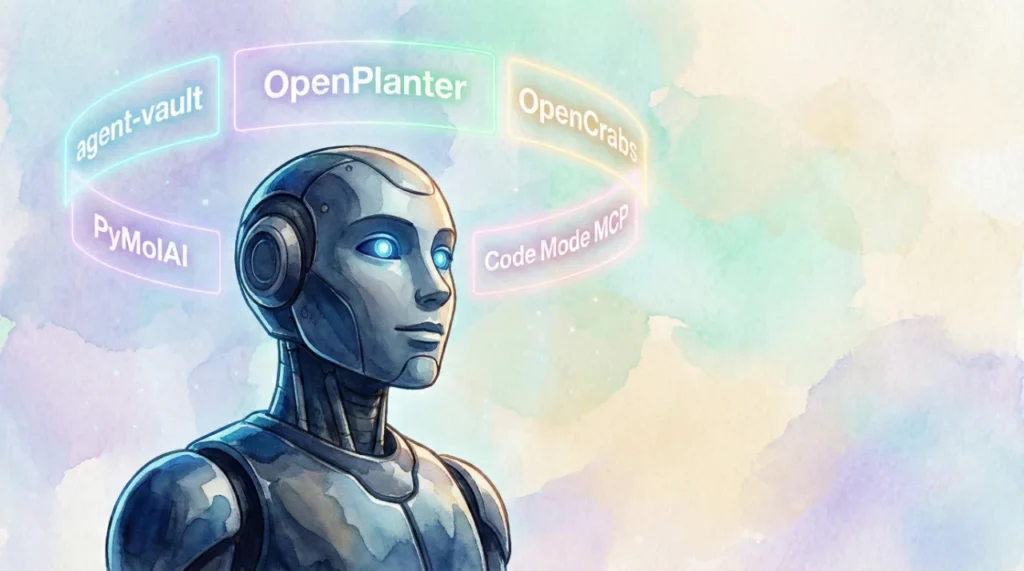
Practical product intelligence for teams building with AI agents
These tools help teams control, extend, or operationalize AI agents in real workflows. They matter because once AI agents move from demos into production systems, issues like security, orchestration, and data access quickly become real risks. Open-source projects are increasingly filling those gaps. But not all of them are equally mature or ready for serious deployment.
Key Summary
- These five open-source projects focus on agent security, orchestration, infrastructure access, bio workflows, and surveillance analysis.
- All are free to use, but operational cost depends on hosting, LLM usage, and integration complexity.
- The strongest immediate practical value today: Cloudflare’s MCP server for teams already using Cloudflare infrastructure.
- Highest security value: agent-vault for isolating sensitive credentials from autonomous agents.
- Most experimental: OpenPlanter and OpenCrabs, which require significant technical expertise to operate effectively.
- Tradeoff: Open source gives flexibility, but you assume integration burden, reliability risk, and long-term maintenance uncertainty.
Agent-vault (botiverse)
GitHub: https://github.com/botiverse/agent-vault
Version reviewed: 1.0.0
Evaluation basis: Documentation review and architecture analysis
What It Actually Does
agent-vault is a secure storage layer designed to prevent AI agents from directly accessing sensitive credentials or secrets.
In plain terms: it keeps passwords, API keys, and tokens away from AI agents while still allowing agents to trigger actions safely.
This matters because modern agent systems often execute code, call APIs, and access databases. If an agent has direct access to secrets, a prompt injection attack could extract them.
Core Architecture
agent-vault acts as a mediation layer:
- Secrets are stored securely.
- Agents request actions instead of secrets.
- The vault validates and executes permitted operations.
This reduces the risk of an LLM accidentally revealing credentials.
Workflow Breakdown
Let’s imagine a customer support automation system:
User Input:
An AI agent receives a request to refund a customer.
System Process:
The agent determines it needs to call a payment API.
Instead of reading the API key directly, it sends a structured request to agent-vault.
Vault Action:
agent-vault checks permissions.
If allowed, it executes the API call using stored credentials.
Output:
The refund confirmation is returned.
The agent never sees the raw API key.
Where Value Is Created
- Stronger isolation from prompt injection.
- Reduced risk of secrets leakage.
- Cleaner separation between reasoning and execution.
Friction Points
- Requires architecture redesign if your agents already access secrets directly.
- Limited documentation depth at this stage.
- Security guarantees depend on implementation discipline.
Ideal Users
- Teams building internal AI automation tools.
- Developers deploying agent workflows in production environments.
Not Ideal For
- Hobby projects.
- Non-technical users.
Pricing Reality
Free software.
But hosting, LLM usage, and infrastructure costs remain.
A small internal deployment might cost:
- $50–$200/month in LLM usage
- Dev time for integration
Competitive Context
Alternatives:
- Traditional secret managers (e.g., HashiCorp Vault)
- Custom middleware
agent-vault differentiates by being designed specifically for AI agent mediation.
Sustainability Risk
Small project. Community-driven.
Longevity depends on contributor activity.
PyMolAI
Website: https://www.pymolai.com/
Version: 1.0.0
Evaluation: Documentation and positioning review
What It Does
PyMolAI adds an AI-driven agent interface to PyMol workflows.
In simple terms: it lets researchers interact with molecular visualization and analysis tools using natural language instructions.
Why That Matters
PyMol is powerful but complex. Many tasks require scripting or manual manipulation. AI mediation lowers the learning curve.
Workflow Example
User Input:
“Highlight hydrogen bonds and export a high-resolution image.”
System Process:
The agent interprets the request.
It translates the request into PyMol commands.
Output:
Annotated molecular structure image.
Where It Adds Value
- Speeds up repetitive scripting.
- Reduces barrier for new researchers.
Limitations
- Accuracy depends on prompt parsing.
- Not replacing domain expertise.
- AI errors could produce misleading visualizations.
Cost Reality
Free open-source.
But requires:
- PyMol installation
- LLM access (if external API used)
Competitive Landscape
Indirect competitors:
- Manual PyMol scripting
- Custom Jupyter workflows
PyMolAI’s differentiation is convenience, not new scientific capability.
Who Should Consider It
- Academic labs.
- Research assistants.
- Computational chemistry students.
Who Should Avoid
- Regulated pharmaceutical pipelines requiring strict validation.
OpenPlanter
GitHub: https://github.com/ShinMegamiBoson/OpenPlanter
Version: 1.0
Evaluation: Documentation and tool architecture review
What It Does
OpenPlanter is a recursive AI agent built for micro-surveillance and digital forensics analysis across diverse data sources.
In simple language: it analyzes structured and unstructured data to find patterns, resolve entities, and detect anomalies.
Workflow Breakdown
Imagine analyzing suspicious financial activity:
Input:
CSV transaction logs
Chat transcripts
Email archives
Process:
- Sub-agents are spawned.
- Entity resolution connects identities across datasets.
- LLM-based anomaly detection flags irregular patterns.
Output:
Structured investigative report.
Value Creation
- Automates cross-data analysis.
- Reduces manual investigative time.
Major Friction
- Requires significant technical setup.
- High risk of hallucinated analysis.
- Not production-ready for legal-grade investigations.
Cost Modeling
Software is free.
Real cost = LLM usage.
Large dataset analysis could easily exceed:
- $300–$1,000/month in API costs.
Competitive Landscape
Competitors:
- Palantir (enterprise)
- Custom Python data pipelines
OpenPlanter is experimental compared to enterprise forensic platforms.
Who Should Test
- Research teams.
- Security analysts exploring agent architectures.
Who Should Avoid
- Organizations needing compliance-certified tools.
OpenCrabs
GitHub: https://github.com/adolfousier/opencrabs
Version: 1.0.0
Evaluation: Documentation and feature overview
What It Does
OpenCrabs is an orchestration layer for integrating multiple AI tools into development workflows.
In simple terms: it coordinates AI coding assistants and automates parts of software development.
Workflow Scenario
Input:
Developer commits code.
Process:
- AI tool reviews changes.
- Another tool suggests improvements.
- Workflow automation triggers tests.
Output:
Feedback report and code suggestions.
Strengths
- Open orchestration flexibility.
- Good for experimentation.
Weaknesses
- No deep enterprise integration.
- Limited documentation maturity.
- Competes with mature tools like GitHub Copilot workflows.
Switching Costs
Moderate.
You must reconfigure CI pipelines.
Sustainability Risk
High uncertainty.
Small project footprint.
Code Mode MCP Server (Cloudflare)
Blog: https://blog.cloudflare.com/code-mode-mcp/
What It Does
Cloudflare’s MCP server allows AI agents to access the full Cloudflare API efficiently while drastically reducing token usage.
Plain explanation: it lets AI systems control Cloudflare services without wasting large amounts of context memory.
Why That Matters
Large language models have limited context windows.
Traditional API schemas consume thousands of tokens.
Code Mode compresses this interaction to roughly 1,000 tokens.
Workflow Example
Input:
“Create a new DNS record and deploy a Worker.”
Process:
- Agent uses MCP server.
- API access is structured and compressed.
- Commands executed via Cloudflare API.
Output:
Infrastructure updated.
Performance Insight
Cloudflare claims up to 99.9% token reduction compared to traditional MCP servers.
Even if actual savings vary, token efficiency directly reduces LLM costs.
Cost Reality
Free software.
Savings appear in:
- Lower LLM token consumption.
- Faster inference cycles.
Competitive Context
Alternative:
- Custom API wrappers.
- Manual schema trimming.
Cloudflare’s advantage is tight ecosystem integration.
Who Should Adopt
- Teams already using Cloudflare DNS, Workers, or R2.
- Infrastructure-heavy AI automation projects.
Who Should Avoid
- Teams not using Cloudflare services.
Cross-Tool Comparison
| Tool | Maturity | Practical Readiness | Risk Level |
| agent-vault | Early | Moderate | Medium |
| PyMolAI | Early | Niche Ready | Medium |
| OpenPlanter | Experimental | Low | High |
| OpenCrabs | Experimental | Low-Moderate | High |
| Code Mode MCP | Backed by Cloudflare | High | Low |
Final Decision Framework
Adopt Immediately
- Cloudflare MCP server if you already operate inside Cloudflare infrastructure.
- agent-vault if you are deploying agents in production and handling sensitive credentials.
Test Cautiously
- PyMolAI for research labs.
- OpenPlanter for investigative prototypes.
- OpenCrabs for AI-heavy dev teams experimenting with orchestration.
Avoid For Now
- Any of these tools for regulated enterprise production unless thoroughly audited.
What Would Change the Recommendation
- More active contributor communities.
- Clear security audits.
- Enterprise documentation.
- Long-term roadmap commitments.
Open-source agent infrastructure is moving fast.
But production readiness still varies widely.
Adopt strategically, not enthusiastically.