
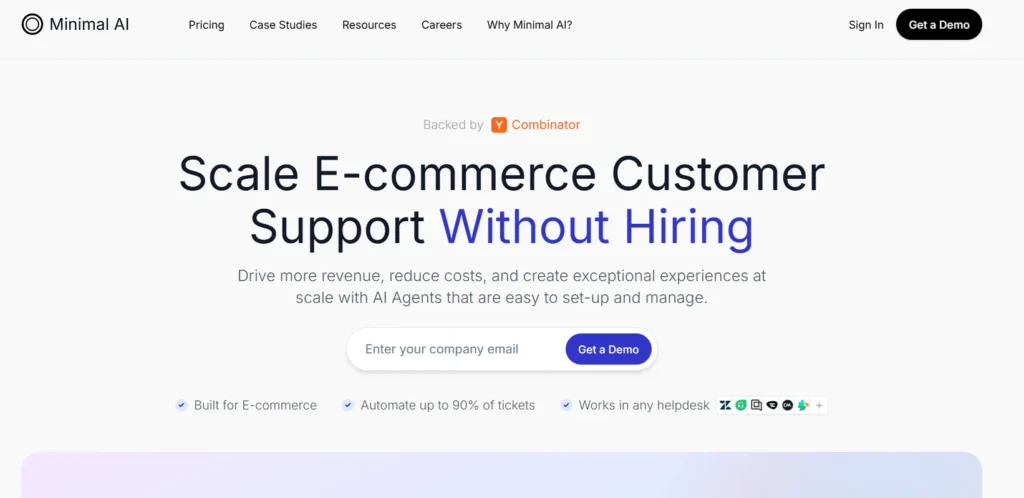
Minimal AI has introduced AI Manager, a new agent designed to automate up to 90% of customer support tickets for e-commerce companies. The launch was announced via Y Combinator on February 23, 2026. The company positions the product as a centralized AI “manager” that can instantly update support agents based on plain-language instructions from operators.
At a moment when online retailers are struggling with rising support costs and fragmented AI tooling, Minimal AI is making a direct pitch: replace complex automation workflows with a single agent that oversees and updates support operations in real time.
Key Summary
- Product launched: AI Manager by Minimal AI, focused on e-commerce support automation
- Core claim: Automates up to 90% of support tickets
- How it works: Operators give plain-language instructions, and the system updates AI support agents instantly
- Target users: E-commerce companies handling high ticket volume
- Why it matters: Reduces support staffing burden while promising faster response times
- Timing: Announced February 23, 2026 via Y Combinator’s launch platform
Product: An AI “Manager,” Not Just a Chatbot
Customer support automation is not new. Many e-commerce companies already use chatbots or AI reply suggestions layered into tools like Zendesk or Shopify inbox systems.
Minimal AI is framing its launch differently.
Instead of offering a chatbot that answers questions, AI Manager acts as a supervisory layer. Operators tell it what they want changed—refund policies, shipping rules, tone adjustments—and the agent updates support behavior across the system immediately.
In plain language, it aims to eliminate the slow process of rewriting macros, retraining models, or manually reconfiguring workflows.
That distinction matters. Most support automation tools focus on answering customers. Minimal AI is targeting the configuration problem behind the scenes.
If it works as described, the product could shift how small and mid-sized online retailers manage scaling pains.
90% Automation Claim
The headline figure—automating 90% of support tickets—is aggressive.
In customer service automation, companies often claim high deflection rates, but real-world performance varies widely based on product complexity, return policies, and customer behavior.
For simple e-commerce stores—clear return windows, predictable shipping times, standardized FAQs—high automation is achievable.
For brands with custom products, subscription issues, or cross-border logistics, automation rates typically drop.
Minimal AI has not publicly released benchmark breakdowns showing ticket categories, response accuracy rates, or escalation frequency. That leaves an open question: is the 90% figure a best-case scenario or a repeatable average?
Developers and operators will test this quickly. Ticket automation is measurable within days.
Competitive Context: A Crowded Field
AI customer support is one of the most saturated verticals in applied AI.
Incumbents include:
- Zendesk AI
- Intercom’s Fin AI
- Shopify’s native AI tools
- Gorgias automation
- Dozens of YC-backed vertical AI startups
Many already promise automated replies, refund handling, and workflow triggers.
Minimal AI’s differentiation hinges on the “AI Manager” concept—an agent that modifies other agents dynamically.
If true, that reduces friction for operations teams. Instead of navigating dashboards or rule trees, managers type instructions like they would message a colleague.
This approach aligns with a broader industry shift toward agentic AI systems that orchestrate tasks rather than just generate text.
The competitive risk is clear: larger platforms could integrate similar supervisory agents directly into their ecosystems.
Why Timing Matters Now
E-commerce margins are tightening globally.
Paid acquisition costs remain volatile. Returns are expensive. Cross-border logistics create unpredictable support loads.
Support teams often scale faster than revenue during peak seasons.
At the same time, large language models have matured enough to handle nuanced policy reasoning and tone adaptation.
Minimal AI is launching at a moment when automation quality has improved significantly, but human staffing costs have not declined.
For small and mid-size retailers especially, the promise of cutting manual ticket handling by even 50% is economically meaningful.
If 90% is realistic, that becomes a structural cost shift.
Business Model and Enterprise Questions
The launch materials did not disclose pricing.
That omission matters.
Support automation pricing typically follows one of three models:
- Per seat
- Per ticket resolved
- Tiered monthly plans based on usage
If AI Manager truly replaces human handling at scale, pricing will determine whether the product is a margin saver or simply shifts costs from labor to software.
Enterprises will also ask about:
- Integration depth with Shopify, WooCommerce, Magento
- Refund authority controls
- Audit logs and compliance safeguards
- Escalation accuracy
Automating refunds without guardrails can quickly erode margins.
This is where many automation tools struggle—balancing speed with financial risk management.
Adoption Friction Risk
Support automation sounds straightforward. In practice, companies hesitate to give AI direct authority over customer outcomes.
The biggest adoption barrier will not be technical performance. It will be trust.
Retailers want assurance that:
- AI responses match brand tone
- Refund decisions follow policy precisely
- Edge cases escalate correctly
If AI Manager genuinely allows operators to update behavior instantly through natural instructions, that reduces one friction layer.
But long-term adoption will depend on visibility. Operators need dashboards, logs, and override capabilities.
Without that transparency, automation claims can quickly unravel under real-world variability.
Strategic Angle
Here is the central editorial question.
Is Minimal AI solving a real workflow bottleneck—or reframing existing automation features under a new label?
The idea of updating AI behavior through natural language is compelling.
If current tools require technical configuration or multi-step updates, a manager-style agent could meaningfully reduce operations time.
If, however, it replicates macro editing and rule changes already available elsewhere, differentiation may be thin.
The first group watching closely will not be investors.
It will be support managers.
They will test how fast policy changes propagate, how clean the automation looks in edge cases, and whether customer satisfaction scores hold steady.
That data will determine whether this is incremental or disruptive.