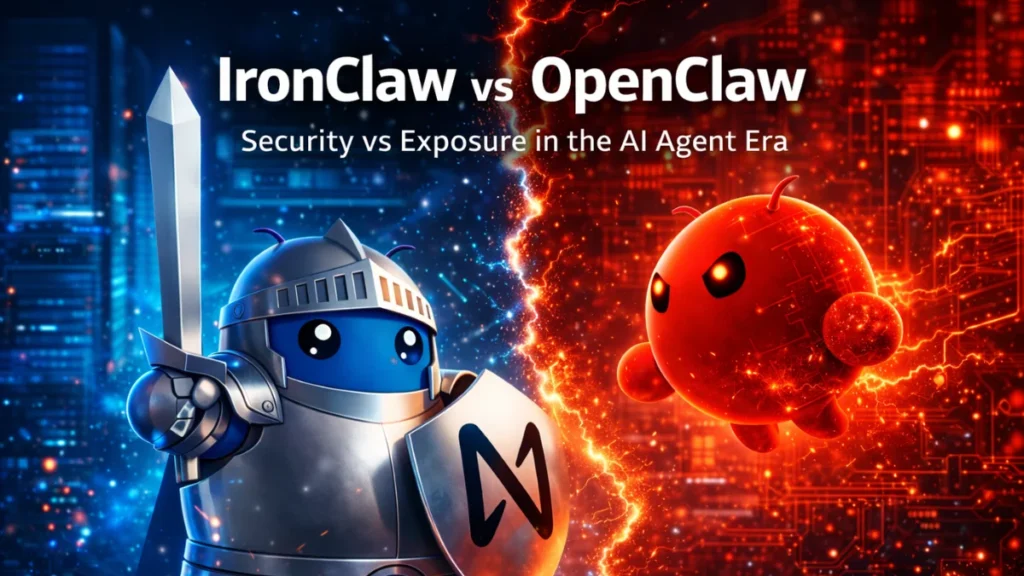
IronClaw helps teams automate tasks with AI agents without exposing passwords or sensitive data. That matters because AI agents don’t just answer questions — they log into systems, run tools, and handle credentials. If those credentials leak, automation becomes a liability instead of an asset. IronClaw is built to prevent that.
Key Summary
- What it does: IronClaw is a security-focused AI agent framework designed to automate tasks like web browsing, API calls, and tool execution without exposing private keys or secrets.
- Who it’s for: Best suited for startups, SaaS teams, and enterprises handling sensitive data — not casual hobbyists.
- Core strength: Secrets stay encrypted and isolated from the AI model itself; tools run in sandboxed environments.
- Practical workflow edge: You can define strict policies for what the agent is allowed to do and review audit logs afterward.
- Pricing reality: Open-source framework; real cost comes from infrastructure, engineering time, and model usage.
- Main tradeoff: Higher complexity and setup overhead compared to more open, experimentation-friendly agent systems like OpenClaw.
What IronClaw Actually Is?
IronClaw is an AI agent framework built in Rust and designed around a single premise: AI agents should never directly access your secrets.
To make that understandable in plain terms:
An AI agent is software that can act on your behalf. It can browse websites, run code, send requests to APIs, and automate workflows. But to do that, it often needs credentials — API keys, OAuth tokens, database passwords.
In earlier agent frameworks like OpenClaw, those credentials were often accessible to the model layer or insufficiently isolated. That created real-world trust concerns.
IronClaw attempts to solve this by:
- Storing secrets in encrypted vaults
- Keeping the AI model separate from credentials
- Running tools inside WebAssembly sandboxes
- Enforcing explicit policies about what the agent can and cannot do
- Logging every action for audit visibility
This is not a consumer AI assistant. It is infrastructure for developers and businesses building automation systems.
Evaluation context: This analysis is based on documentation review, GitHub architecture inspection, and comparison to established AI agent frameworks. No direct production deployment testing was conducted.
Core Architecture: What’s Different Technically
IronClaw’s core differentiators fall into four areas.
1. Rust-Based Foundation
Rust is a programming language known for memory safety. In practical terms, it reduces certain categories of bugs that can lead to crashes or vulnerabilities.
Why that matters:
When you’re building a long-running agent that executes tools and processes input dynamically, memory safety reduces unpredictable behavior. It doesn’t guarantee security — but it narrows the attack surface.
2. WebAssembly Sandboxing
Each tool runs in its own sandboxed environment using WebAssembly.
Plain explanation:
If one tool breaks or behaves maliciously, it cannot freely access the entire system. It’s isolated.
In workflow terms:
If your agent has:
- A web scraping tool
- A database query tool
- A payment API integration
Each operates inside its own boundary. That dramatically reduces lateral movement risk if something goes wrong.
3. Encrypted Vault for Secrets
The AI model never sees raw secrets.
Instead:
- Secrets live in an encrypted vault
- Policies determine which tool can request which secret
- The model can request an action, but it does not retrieve the credential directly
This design addresses prompt injection risks, where malicious input attempts to trick the model into revealing sensitive data.
4. Policy Enforcement and Audit Logs
You define what the agent is allowed to do.
Examples:
- Only call specific APIs
- Only access certain domains
- Never execute shell commands
- Require approval for financial transactions
Everything is logged.
For enterprises, this is non-negotiable.
Real Workflow Breakdown: Automating Customer Support Ticket Triage
Let’s ground this in a realistic scenario.
Use Case: SaaS Support Automation
A SaaS company wants an AI agent to:
- Monitor incoming support emails
- Classify urgency
- Check user account data
- Generate draft responses
- Escalate high-risk cases
Step 1: Inputs
- Incoming support email text
- CRM API key
- Internal knowledge base
- Ticketing system credentials
Step 2: Processing in IronClaw
- The model analyzes the email content.
- It requests account lookup via a CRM tool.
- The CRM tool retrieves credentials from the encrypted vault.
- The CRM tool runs inside its sandbox.
- The model receives structured data (not raw credentials).
- Policy engine verifies whether escalation rules apply.
- Draft response is generated.
Step 3: Output
- Classified ticket
- Structured metadata
- Suggested response
- Escalation flag
Where Value Is Created
- Reduced manual triage time
- Structured automation without exposing CRM API keys
- Clear action logs for compliance
Where Friction Appears
- Policy configuration requires careful setup
- Engineering team must define allowed actions
- Debugging sandbox interactions adds complexity
Where Expectations May Fail
If a team expects “plug and play automation in 10 minutes,” IronClaw will disappoint.
It’s a framework, not a consumer app.
IronClaw vs OpenClaw: What the difference
OpenClaw gained popularity because it made AI agents easy to experiment with.
That ease came with looser control boundaries.
IronClaw’s differentiation is clear:
| Dimension | OpenClaw | IronClaw |
| Secret isolation | Limited | Vault-based, encrypted |
| Tool sandboxing | Broad access | WebAssembly isolation |
| Policy enforcement | Minimal | Explicit rule system |
| Audit logging | Basic or absent | Built-in logging |
| Target audience | Developers, hobbyists | Security-conscious teams |
IronClaw prioritizes governance over speed of experimentation.
That’s a philosophical shift.
Usability and Learning Curve
IronClaw is not beginner-friendly.
Expect:
- Reading architecture docs
- Understanding policy configuration
- Managing vaults and encryption keys
- Defining tool boundaries
Compared to more experimental agent frameworks, setup overhead is higher.
But for regulated industries, that overhead is expected.
Healthcare, fintech, legal — these environments already require structured governance.
Performance and Reliability
No independent benchmarks are publicly available comparing execution latency between IronClaw and OpenClaw.
However:
- Rust foundation likely improves runtime stability.
- WebAssembly sandboxing may introduce minor overhead.
- Policy enforcement adds evaluation steps per action.
In high-throughput environments, engineering teams should test scaling behavior under load before production deployment.
Pricing and Cost Modeling
IronClaw is open source.
That does not mean “free.”
Real cost components:
1. Infrastructure
- Hosting agent services
- Secure vault infrastructure
- Logging storage
2. Model Usage
If using GPT-class models:
- $0.01–$0.06 per 1K tokens (varies by provider)
Heavy automation workflows can reach:
- $200–$1,000 per month in model costs for small teams
- $5,000+ monthly for enterprise-scale deployments
3. Engineering Time
Initial setup may require:
- 2–6 weeks for a small engineering team
- Security review cycles
IronClaw reduces breach risk — but increases implementation effort.
Switching Costs and Migration Friction
If you’re already using OpenClaw:
Migration considerations:
- Rewriting tool interfaces
- Reconfiguring credential management
- Defining new policy rules
- Testing sandbox boundaries
Data portability risk is moderate. Since both frameworks are code-driven, migration is possible but non-trivial.
Switching cost is primarily engineering labor.
Scalability and Enterprise Readiness
IronClaw appears designed for enterprise adoption:
- Clear audit logs
- Policy control
- Secret vault isolation
- Architectural defensibility
However:
Enterprise readiness also depends on:
- Documentation depth
- Support channels
- Security certifications (none publicly documented yet)
Without SOC 2 or formal compliance signals, large enterprises will still conduct independent reviews.
Security and Data Handling Transparency
IronClaw’s biggest claim is architectural isolation.
Key strengths:
- Secrets not exposed to model
- Tool isolation
- Explicit policies
- Logging visibility
Unknowns:
- External audit validation
- Third-party penetration testing results
- Formal compliance certifications
Security-first architecture is promising, but enterprises will require independent validation.
Long-Term Sustainability
IronClaw’s sustainability depends on:
- Community growth
- Contributor velocity
- Documentation maturity
- Adoption by serious teams
Security-focused agent frameworks align with industry direction. As AI agents move into enterprise workflows, secure-by-default systems will likely outlast experimental frameworks.
However, smaller community size is a risk.
If contributor momentum slows, ecosystem support may lag behind competitors.
Who Should Adopt, Test, or Avoid the IronClaw
Adopt Immediately If:
- You’re building AI agents that access sensitive APIs
- You operate in regulated environments
- You need policy enforcement and audit logs
- You cannot tolerate credential exposure risk
Test Cautiously If:
- You’re a startup exploring automation
- You have limited security infrastructure
- You want stronger controls but lack dedicated DevOps
Avoid For Now If:
- You’re experimenting casually
- You want fast prototyping without configuration overhead
- You lack engineering resources
What Would Change the Recommendation
- Public security audits
- SOC 2 or compliance certifications
- Clear enterprise case studies
- Simplified onboarding layers for smaller teams