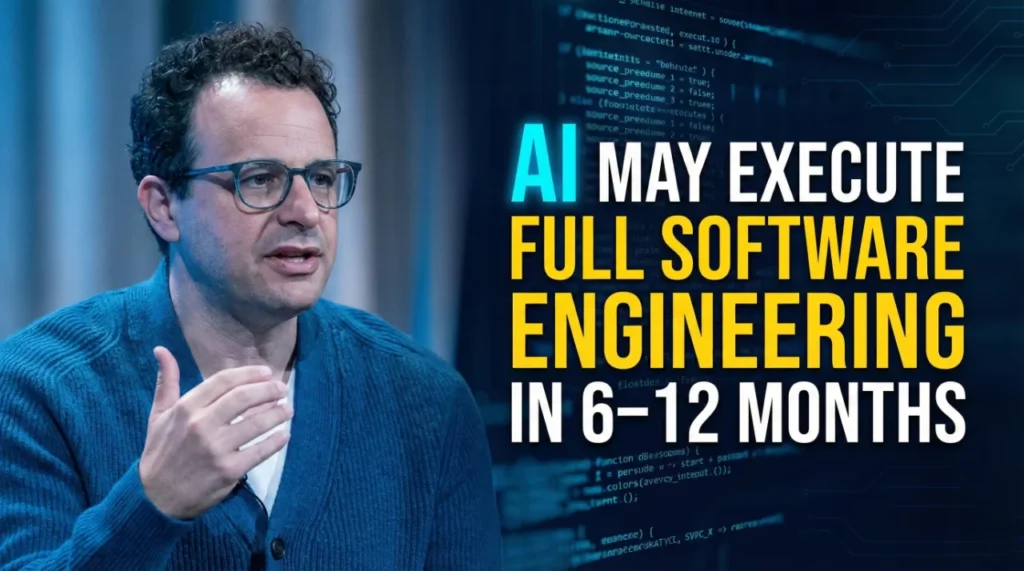
Dario Amodei’s latest forecast signals a potential capability inflection point for AI coding systems and raises new questions about developer roles, enterprise adoption, and competitive pressure in the model race.
Artificial intelligence may soon handle the full lifecycle of software engineering, according to Dario Amodei, chief executive of Anthropic. Speaking at the World Economic Forum in Davos last month, Amodei said advanced AI models could be “6 to 12 months away” from performing everything software engineers do end to end.
The prediction marks an escalation from his earlier mid-2025 estimate that AI systems would generate 90% of code. Now, he suggests the remaining gap—architecture, debugging, deployment, iteration—may close faster than many expected. If accurate, the shift would represent a structural turning point in how software is built and who holds leverage in the AI ecosystem.
The timing matters. Enterprises are already embedding AI copilots into development workflows. Startups are restructuring teams around AI-first tooling. And leading model providers are racing to prove their systems can move beyond autocomplete toward autonomous execution.
Key Summary
- Anthropic CEO Dario Amodei said AI could perform full end-to-end software engineering within 6 to 12 months.
- The forecast builds on his earlier claim that AI would soon generate 90% of code.
- Anthropic employees reportedly focus more on architecture and refinement as AI handles larger coding workloads.
- Developers broadly report using AI tools in more than half of their daily tasks.
- The shift signals a possible AI capability inflection with implications for jobs, enterprise adoption, and competitive positioning among model providers.
From Code Generation to Full Autonomy
To understand the weight of Amodei’s prediction, it helps to define what “end to end” software engineering actually involves.
Software engineering is not just writing lines of code. It includes designing system architecture, selecting infrastructure, implementing features, testing for bugs, securing data, deploying to production, and maintaining updates over time. Today’s AI coding tools—whether from Anthropic, OpenAI, or others—primarily assist with writing and debugging snippets of code.
Amodei’s claim implies something broader: models capable of taking a high-level instruction and producing a fully functional system, managing its dependencies, iterating based on performance feedback, and resolving issues without step-by-step human direction.
In plain terms, that would mean AI not just helping engineers but acting as the engineer.
Anthropic employees, according to Amodei, are already shifting their roles. Rather than writing most of the code themselves, they increasingly focus on high-level system design and refinement, allowing AI systems to handle much of the implementation. That dynamic creates what he describes as a feedback loop. Better models produce better internal tooling, which in turn accelerates the development of even more capable models.
This is more than workflow optimization. It is an attempt to compress the AI improvement cycle itself.
Anthropic CEO, Dario Amodei:
— CG (@cgtwts) February 21, 2026
"We might be 6-12 months away from models doing all of what software engineers do end-to-end”.
pic.twitter.com/EsHylaSaEt https://t.co/hyXEXUwnSH
Capability Inflection, Not Just a Productivity Boost
The broader industry context suggests this is not an isolated forecast.
Developers across companies report using AI coding assistants for a majority of their tasks—some surveys suggest around 60 percent of daily work involves AI assistance. While those figures vary by company and role, the pattern is consistent. AI is no longer experimental in software teams. It is embedded.
The shift from 60$ assistance to full autonomy, however, represents a different category of change.
Incremental productivity gains—faster code completion, automated testing suggestions—reshape workflows but preserve human oversight. Full end-to-end autonomy could alter headcount models, team composition, and hiring strategy. Early-stage startups might require fewer engineers to launch products. Large enterprises could reallocate developer budgets toward AI infrastructure and governance.
If models can independently implement production-ready systems, the bottleneck in software creation moves upstream. The scarce resource becomes not code, but product judgment, architectural foresight, and domain expertise.
That transition would reward companies that control the most capable models and the compute infrastructure behind them.
Competitive Escalation Among Model Providers
Amodei’s timeline also functions as competitive signaling.
Anthropic competes directly with model providers such as OpenAI and Google DeepMind. Each is racing to demonstrate that their large language models can reason, plan, and execute complex tasks beyond text generation.
Coding has become a proving ground. It offers measurable benchmarks and clear economic value. If Anthropic can credibly claim its systems perform full engineering cycles, it strengthens its case with enterprise buyers and cloud partners.
The economic stakes are significant. Software development is a multi-trillion-dollar global industry. Even partial automation redistributes value toward infrastructure providers and model developers.
The claim also pressures competitors to match or exceed the forecast. In AI, expectations often shape investment flows as much as present capability.
Labor Implications Without Certainty
Despite the ambitious timeline, caution remains widespread among developers.
Many engineers welcome AI assistance for routine tasks but remain skeptical about full autonomy in complex systems. Edge cases, security vulnerabilities, compliance requirements, and performance optimization often require contextual judgment that current models struggle to maintain consistently over long workflows.
In simple terms, writing code is one challenge. Owning a system in production—where errors carry financial and legal risk—is another.
That tension explains the mixed reactions across developer communities. Productivity gains are tangible. Job displacement fears are also real. Yet few credible industry observers argue that human oversight will disappear entirely in the near term.
More likely is a shift in role definition. Engineers may spend less time implementing features and more time validating outputs, designing architectures, and defining constraints.
Whether that reduces total engineering employment or reshapes it remains uncertain.
Infrastructure Dimension
Behind the headline prediction lies an infrastructure question.
If AI systems are to handle full engineering tasks, they must maintain persistent memory across large codebases, manage version control, simulate testing environments, and integrate with deployment pipelines. That requires not just smarter models, but robust tooling ecosystems and cloud infrastructure.
Anthropic’s internal usage hints at that integration path. But the company has not publicly detailed the tooling stack or autonomy safeguards supporting such workflows.
The gap between laboratory capability and enterprise deployment often lies in reliability, auditability, and compliance. For regulated industries—finance, healthcare, government—AI autonomy introduces additional scrutiny.
That reality could slow adoption even if technical capability advances rapidly.
What Comes Next
Amodei’s forecast may prove optimistic. AI timelines often compress in executive rhetoric. But even if the 6-to-12-month window stretches longer, the direction of travel is clear.
Coding is becoming the frontline test of whether AI systems can move from assistance to agency.
If models achieve sustained, reliable autonomy in software engineering, the ripple effects will extend beyond developer desks. Venture capital allocation, startup formation costs, enterprise IT budgets, and competitive moats across the software industry could all shift.
For now, the industry sits in a transitional phase—heavy AI assistance, partial autonomy, growing confidence, and persistent doubt.
The next year will test whether AI coding systems remain powerful copilots or step into the driver’s seat.