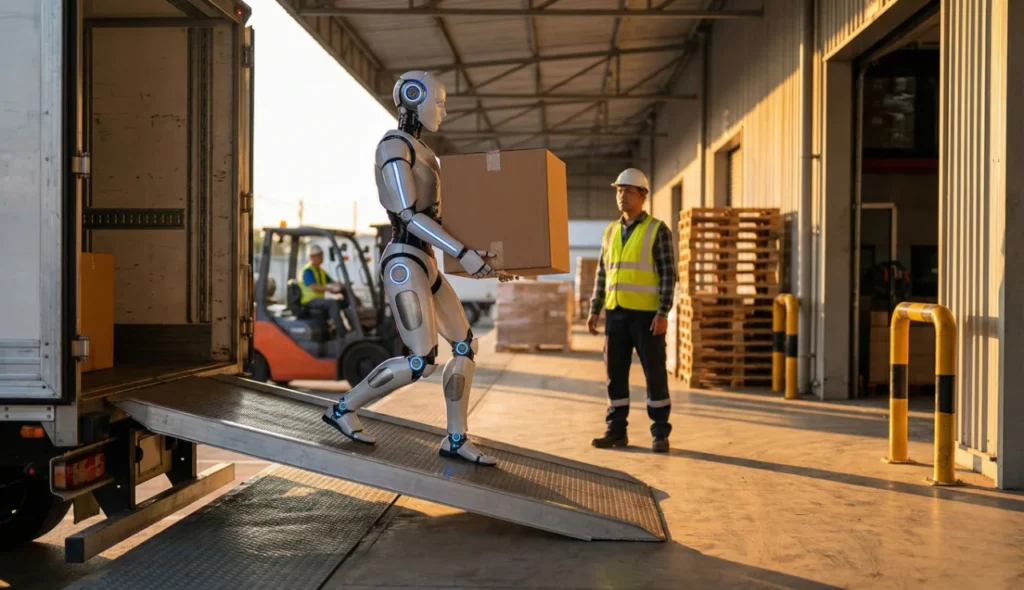
Humanoid robotics just got a massive capital injection.
Austin-based Apptronik has secured a $520 million Series A extension, pushing its total funding to nearly $1 billion and valuing the company between $5 billion and $5.5 billion. The deal ranks among the largest single raises in the emerging humanoid robotics category.
The message from investors is clear: scaling AI-powered humanoids is no longer speculative — it’s operational.
What Just Happened
Apptronik announced it raised more than $935 million in total Series A funding, including the newly disclosed $520 million Series A-X extension. The company employs nearly 300 people and plans to use the new capital to accelerate production of its humanoid robot, Apollo.
The company originated from robotics research at the University of Texas at Austin, building on work connected to Valkyrie, developed in collaboration with NASA.
Apptronik says the new funds will:
- Expand Apollo manufacturing
- Scale global pilot programs
- Deepen partnerships, including projects with Mercedes-Benz
- Advance AI collaboration with Google DeepMind
- Support a new robot reveal later this year
CEO Jeff Cardenas described the round as validation that humanoids designed to safely work alongside people are reaching commercial maturity.
Today, we’re excited to announce that we’ve raised more than $935M in Series A funding with a $520M Series A-X extension round, bringing our total capital raised to nearly $1B.
— Apptronik (@Apptronik) February 11, 2026
This milestone is a powerful vote of confidence in our mission: building AI-powered humanoid robots…
Why This Matters
Humanoid robotics has moved from lab demos to enterprise trials, but capital intensity remains the biggest barrier to scale.
Building general-purpose robots that operate in human environments requires hardware engineering, safety validation, AI training, and manufacturing infrastructure — all expensive, long-cycle investments. Nearly $1 billion in funding gives Apptronik the runway to tackle those challenges without immediate capital pressure.
For industrial sectors facing workforce constraints and rising operational costs, humanoids promise a flexible automation layer that doesn’t require redesigning facilities around fixed machinery.
This funding round suggests investors believe that moment is approaching.
Expert Analysis
The size and structure of this raise indicate that the humanoid market is entering its scale phase — the most difficult part of robotics commercialization.
Unlike software AI startups, robotics companies cannot iterate overnight. Every deployment must balance mechanical reliability, perception accuracy, power management, and safety compliance. Failures are physical, not just digital.
Partnerships are particularly telling. Work with Mercedes-Benz points toward automotive manufacturing use cases — repetitive, structured tasks where humanoids can complement existing automation. Collaboration with Google DeepMind suggests Apptronik may be integrating advanced foundation models to improve perception, reasoning, and adaptability in dynamic environments.
If those integrations deliver measurable productivity gains, humanoids shift from experimental tools to infrastructure assets.
Comparison
Investment in humanoid robotics has accelerated globally over the past two years, with multiple startups announcing pilot deployments. Yet few have demonstrated consistent, large-scale commercial operation.
Apptronik’s nearly $1 billion capital base positions it among the best-funded players in the category, giving it both time and leverage in a rapidly intensifying competitive landscape.
What Happens Next
Key indicators to watch:
- Expansion of Apollo into production environments
- Proof of manufacturing scale and cost control
- Revenue conversion from pilot programs
- Details on the company’s upcoming robot
The next phase will be less about prototypes and more about performance metrics: uptime, safety records, throughput improvements, and cost per task.
Final Take
This funding round marks a turning point for Apptronik and for humanoid robotics more broadly. Investors are backing not just a concept, but production.
With nearly $1 billion in capital and high-profile industrial partnerships, Apptronik now faces the defining challenge of robotics: turning technical promise into dependable, scalable operations. The next year will determine whether humanoids become a standard tool in industry — or remain an ambitious bet.