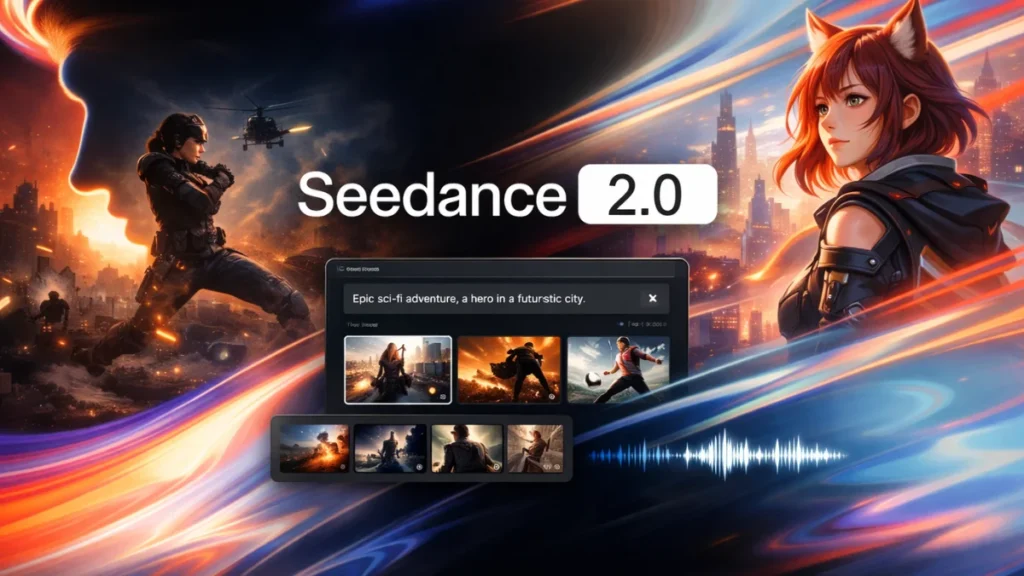
ByteDance has quietly crossed a line many in Hollywood assumed was still years away. Its new video model, Seedance 2.0, can generate polished, cinematic scenes—complete with sound, motion continuity, and accurate lip-sync—from a single prompt. The release matters because it compresses what once took teams, budgets, and weeks into minutes, inside a consumer-facing tool.
The model is now live inside CapCut, available on web, desktop, and mobile. That placement alone signals intent: this isn’t a lab demo. It’s production-ready.
From Short Clips to Structured Scenes
Early AI video tools were impressive in flashes but brittle in practice. They produced isolated shots that creators had to stitch together manually, often with mismatched motion, lighting, or pacing. Seedance 2.0 takes a different approach. It generates native multi-shot sequences—action that flows across cuts as if it were storyboarded.
Under the hood, the system can blend inputs flexibly: a block of text, a single image, up to nine images, or multiple video clips. The output lands at full HD (1080p), with physics that look believable and motion that doesn’t collapse under scrutiny. Fight choreography, sports highlights with slow motion and voiceover, and dialogue scenes with accurate mouth movement are all part of the standard demo set—not edge cases.
One detail professionals will notice immediately: lip-sync is handled at the phoneme level across multiple languages. That’s the difference between a novelty clip and something that can plausibly be used in advertising, anime-style shorts, or narrative video.
Why ByteDance Is Positioned to Pull This Off
ByteDance’s advantage isn’t just technical talent; it’s distribution. CapCut already sits at the center of short-form video workflows for millions of creators who publish to TikTok, Instagram Reels, and YouTube Shorts. By embedding Seedance 2.0 directly into that ecosystem, ByteDance bypasses the usual adoption friction that slows down new creative tools.
The company also optimized the model for speed. Generation times are reportedly about 30% faster than the previous version, making iteration practical rather than theoretical. For creators, that means fewer overnight renders and more real-time experimentation.
This combination—quality, speed, and reach—is what has triggered both excitement and anxiety across the industry.
Not the End of Filmmaking—But a Shift in Power
The loudest fear is obvious: if AI can generate cinematic scenes on demand, what happens to traditional production roles? The quieter reality is more nuanced. Tools like Seedance 2.0 don’t eliminate the need for storytelling; they expose its absence.
A technically perfect video with no narrative hook still fails. What changes is who gets to try. Independent creators, small studios, and brands without seven-figure budgets can now prototype ideas visually, test concepts, and refine tone before committing serious resources.
For experienced professionals, this shifts the value equation. Direction, pacing, writing, and taste matter more—not less—when execution becomes cheap. The bottleneck moves from production to imagination and judgment.
Why This News Matters
Creators: Solo filmmakers, YouTubers, and animators can now produce scenes that previously required crews or expensive software stacks. That lowers the barrier to entry across ads, shorts, and experimental film.
Brands and advertisers: Rapid iteration becomes possible. Campaign ideas can be visualized, tested, and localized without reshoots or location costs.
Media and entertainment: Previsualization, concept trailers, and even low-budget narrative content become faster and cheaper to develop—potentially reshaping how projects get greenlit.
Audiences: Expect a surge in visually polished content, but also more noise. Quality storytelling will be the differentiator, not production gloss.
The Skepticism Is Real—and Reasonable
There are legitimate concerns. AI-generated video raises unresolved questions around training data, creative ownership, and visual sameness. If everyone uses the same models, will everything start to look the same? And while demos are impressive, edge cases—hands, continuity over longer narratives, emotional subtlety—still challenge AI systems.
Professionals also point out that “Hollywood-quality” visuals don’t automatically equal Hollywood-quality storytelling. Tools don’t replace experience; they amplify it.
What Comes Next
Expect three clear trends:
- Short-form storytelling explodes. Ads, anime-style narratives, and serialized shorts will be early beneficiaries.
- Preproduction changes first. Storyboards, animatics, and pitch visuals will increasingly be AI-generated, even for traditional film and TV projects.
- Talent shifts upstream. Writers, directors, and creative leads who can articulate strong ideas will gain leverage as execution costs fall.
Seedance 2.0 doesn’t end filmmaking. It redraws the map. And like every major shift in creative technology, the real winners won’t be the tools themselves—but the people who learn how to think differently because of them.