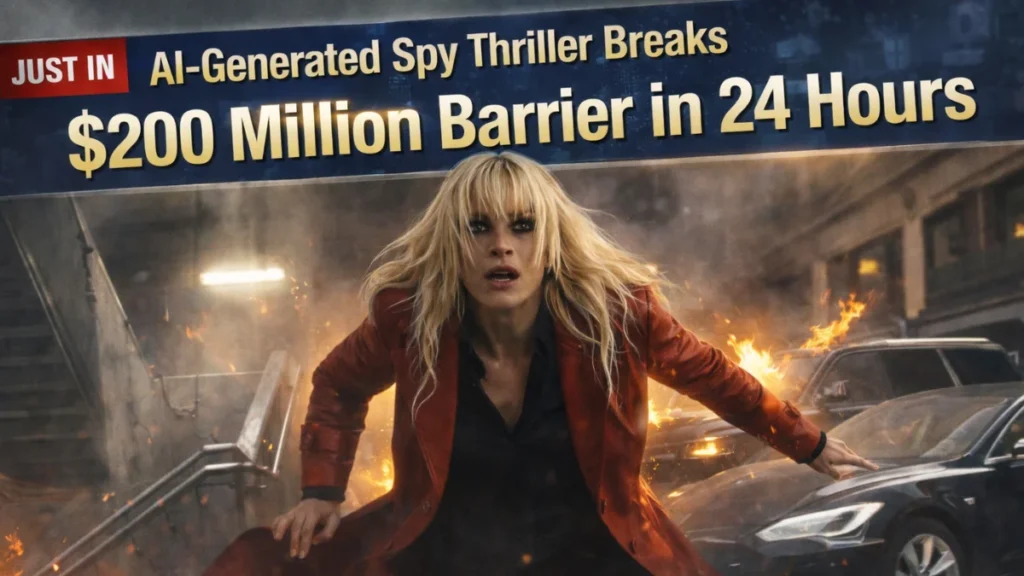
A Berlin duo says they built the visual equivalent of a 200 million spy thriller in a single day without cameras, actors, or a production crew. The claim made by The Dor Brothers is not about box office receipts.
It is about collapsing the cost structure of cinematic spectacle.
For American studios already navigating labor tensions and streaming era economics, that is the real disruption.
Within hours of posting their three minute short on X, the clip drew millions of views and ignited a split reaction. Technologists called it inevitable. Creatives called it soulless. Executives quietly saw a budget model under pressure.
The Dor Brothers said the film was created using tools including Kling, Runway, and Flux. No set builds. No union crews. No physical production footprint.
The 200 million number is rhetorical. The structural shift is not.
We just made a $200,000,000 AI movie in just one day.
— The Dor Brothers (@thedorbrothers) February 16, 2026
Yes, this is 100% AI. pic.twitter.com/TMotM7rguY
Production Model That Bypasses the Set
Hollywood has absorbed technical innovation for decades. Digital cameras, CGI pipelines, virtual LED stages each reduced friction while keeping the industry’s labor and financing architecture intact.
AI native production threatens something deeper. Coordination itself.
A studio tentpole traditionally requires months of planning, insurance coverage, physical locations, layered vendor contracts, and thousands of paid labor hours. AI compresses much of that into software workflows and compute cycles. Instead of mobilizing crews, creators orchestrate models.
That distinction matters.
Lower equipment costs are incremental. Lower coordination costs are systemic.
If cinematic pre visualization, concept sequences, and even finished scenes can be generated in hours rather than weeks, the development pipeline shortens dramatically. In a streaming market obsessed with speed and cost discipline, that optionality becomes strategic leverage.
New Creative Stack in Action
The short demonstrates how AI filmmaking is less about one breakthrough model and more about integration.
- Kling generates dynamic text to video scenes.
- Runway refines motion, compositing, and scene continuity.
- Flux handles high detail image generation and stylistic frames.
The breakthrough is not perfection. Observers pointed out physics inconsistencies, facial artifacts, and lighting anomalies. But the rate of improvement across video models over the past 18 months has been steep.
What looked synthetic in early 2024 now requires closer inspection.
For U.S. investors, this shifts the conversation from novelty to infrastructure. The durable companies may not be those chasing viral clips, but those building workflow layers studios can plug into.
Where This Collides With Labor
Hollywood remains one of the most unionized industries in America. AI was central to the Writers Guild and SAG AFTRA strikes in 2023, particularly around digital likeness rights and automated script generation.
The Dor Brothers’ experiment does not violate those contracts.
But it reframes long term negotiating power.
If studios can prototype high concept sequences without actors or physical sets, they gain flexibility in early stage development. That does not eliminate storytelling. It reduces reliance on large crews for certain production layers, especially VFX heavy sequences and background environments.
The immediate effect is not mass layoffs. It is gradual substitution in pre visualization, stunt simulation, digital extras, and world building assets.
When optionality increases on one side of the table, leverage shifts quietly.
Platforms and the Incentive to Amplify
The viral surge reveals another layer. Distribution platforms benefit from spectacle.
A headline claiming a 200 million film built in 24 hours generates engagement whether viewers admire it or criticize it. Debate is productive.
For major U.S. tech platforms, this kind of content drives time on platform while normalizing synthetic media at scale.
That normalization carries regulatory implications.
Financial Implication Few Mention
If high concept visuals become cheap, scarcity shifts.
Production capital may no longer be the bottleneck. Attention becomes the bottleneck.
Lower cost means more content. More content increases oversupply risk. Oversupply compresses margins unless distribution power consolidates.
That dynamic favors companies controlling platforms, franchises, and intellectual property, not necessarily the creators of the tools themselves.
The Dor Brothers’ short is not a replacement for Hollywood blockbusters.
It is a pressure test of the assumptions behind them.
When cinematic spectacle no longer requires industrial scale coordination, the industry does not collapse. It recalibrates.
The real question is whether studios adapt before the cost barrier collapses around them.