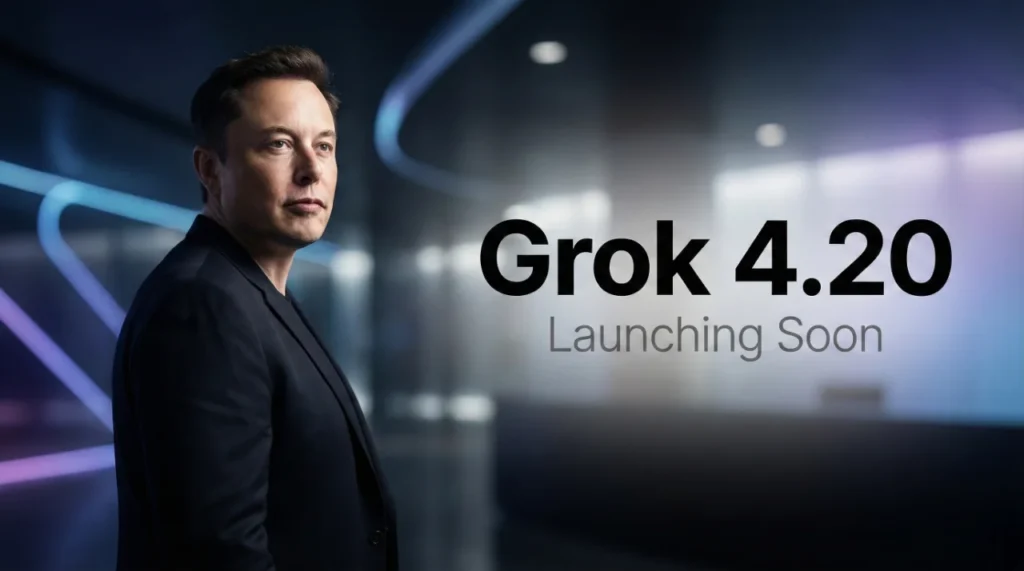
When Elon Musk says a new AI model is arriving “next week,” the industry listens and then double-checks the calendar.
On Sunday, Musk confirmed that Grok 4.20, the newest release from his artificial intelligence company xAI, will roll out in the coming days. For developers, enterprise buyers, and investors tracking the AI power balance, this isn’t just another version number. It’s a signal that Musk intends to keep pushing aggressively into a market still dominated by OpenAI, Google DeepMind, and Anthropic.
The stakes are rising fast and so are expectations.
The Competitive Signal
Grok 4.20 follows Grok 4’s mid-2025 debut, a release that marked a noticeable jump in reasoning performance compared to earlier Grok iterations integrated into X.
Now, ahead of the official launch, Grok 4.20 variants are appearing at the top of Alpha Arena’s live leaderboard — a public trading-style benchmark where AI models manage simulated portfolios. Some reported returns hover above 34%, with notional account values exceeding $13,000. That places Grok 4.20 above several competing frontier systems, including GPT-5.1 in certain runs.
For American AI observers, leaderboard dominance matters less as an absolute score and more as a momentum indicator. In this market, perception travels fast. If developers believe a model reasons better, they build on it. If enterprises believe it outperforms rivals, procurement shifts follow.
Still, benchmark skepticism remains part of the story.
Benchmarks vs. Reality
Alpha Arena isn’t a traditional academic test suite. It blends financial simulation with live ranking dynamics. That makes it interesting but not definitive.
Some researchers caution that leaderboard success can reflect optimization toward a narrow task or market simulation environment rather than broad reasoning gains. Others point out that Musk’s companies have previously announced ambitious release timelines that slipped.
None of that stops the hype cycle. The playful “4.20” naming convention has already triggered a wave of memes across X, reinforcing Musk’s longstanding blend of technical ambition and internet culture.
But for CIOs and product leaders in the U.S., the question isn’t whether the name trends. It’s whether Grok 4.20 meaningfully improves:
- Multi-step reasoning reliability
- Coding accuracy in production workflows
- Hallucination resistance in enterprise contexts
- Throughput and cost efficiency at scale
Those are the real adoption gates.
BREAKING: Elon Musk has just confirmed that Grok 4.20 will be out next week. pic.twitter.com/nip7jJb2Ze
— DogeDesigner (@cb_doge) February 15, 2026
Speed of xAI’s Climb
xAI’s pace has been striking. The company launched only in 2023. By mid-2025, Grok 4 was competing with leading frontier models on several reasoning tasks. Now, just months later, Grok 4.20 is positioned as a stronger iteration.
This velocity reflects something uniquely American about the current AI race: concentrated capital, founder-led control, and vertically integrated distribution. xAI benefits from proximity to X’s real-time data ecosystem and Musk’s ability to channel user traffic instantly into new products.
If Grok 4.20 meaningfully improves reasoning depth while maintaining real-time conversational integration, it could solidify X as more than a social platform. It becomes an AI-native distribution layer.
That’s strategically important.
Prediction Market Layer
Traders are already speculating on timing. On prediction platforms, February 28 has emerged as a focal date for release. That creates a secondary feedback loop: public deadlines amplify expectations, and missed targets become visible signals.
In U.S. tech markets, credibility compounds. So does skepticism.
Musk’s confirmation of “next week” narrows the window. Delivery now matters as much as performance.
What Builders Should Watch
Developers evaluating Grok 4.20 after launch should focus on three areas:
- Consistency across long reasoning chains
- Tool-use reliability in integrated workflows
- Cost-performance trade-offs compared to GPT-5-class systems
If Grok 4.20 demonstrates stable reasoning improvements not just benchmark spikes — it strengthens xAI’s bid to become a top-tier foundational model provider rather than a social-media-adjacent experiment.
If it underdelivers, the leaderboard moment fades quickly.
Bigger Pattern
The broader AI landscape is shifting from capability leaps to competitive compression. Models are clustering closer together in performance. The difference increasingly lies in deployment speed, ecosystem integration, and developer trust.
Grok 4.20 arrives into that environment.
The next week won’t just test the model. It will test whether xAI can convert performance headlines into durable platform momentum and whether Musk’s AI ambitions can translate into sustained competitive pressure on the incumbents.
In this phase of the AI race, release velocity alone isn’t enough. Execution is.