Google is officially pushing Gemini from “smart” to personal—and it knows that’s a risky move.
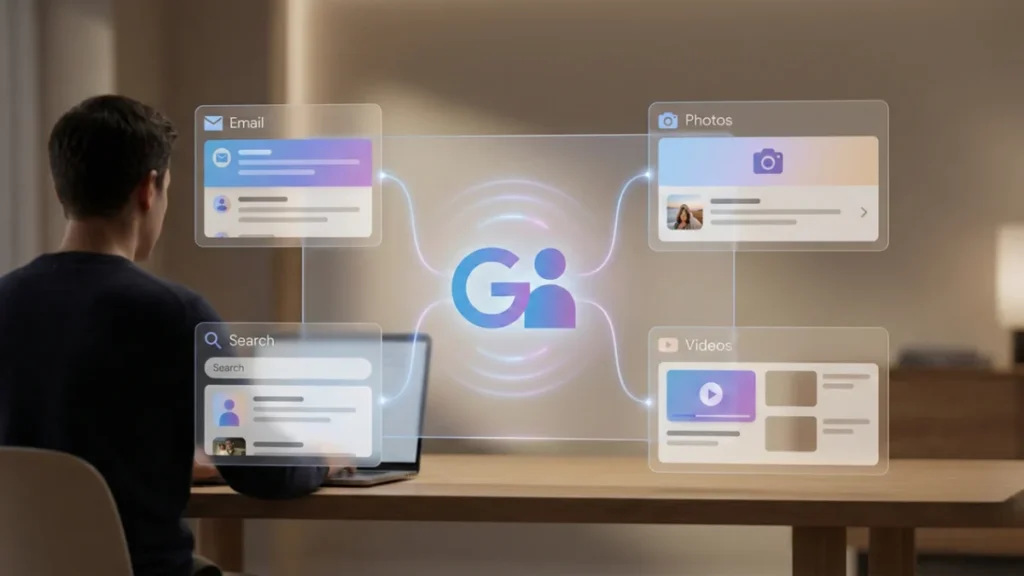
On January 14, Google quietly rolled out Personal Intelligence, a new opt-in capability that allows Gemini to tap into a user’s own Google data—Gmail, Photos, Search, and YouTube history—to deliver answers that are sharply tailored to real life.
The pitch is simple: AI that actually understands context. The reality is more complicated.
What Personal Intelligence Actually Does
Personal Intelligence lets Gemini securely reference information you’ve already shared with Google—but only if you say yes. Once enabled, the assistant can connect dots across apps that usually live in silos.
Ask Gemini about car maintenance, and it might scan old email receipts to identify your Honda Odyssey and suggest compatible tires. Need a haircut? It could recall past appointments and help book the next one. This isn’t guesswork—it’s retrieval.
Crucially, Google says this personal data isn’t used to train its broader AI models. Every answer also shows citations, so users can see exactly where the information came from.
Today, we’re introducing Personal Intelligence.
— Google (@Google) January 14, 2026
With your permission, Gemini can now securely connect information from Google apps like @Gmail, @GooglePhotos, Search and @YouTube history with a single tap to make Gemini uniquely helpful & personalized to *you* ✨
This feature… pic.twitter.com/79zKJGA5ft
Why Google Is Doing This Now
According to Sundar Pichai, this is a foundational step toward AI systems that can reason across personal sources—not just public knowledge.
In a post on X, Google framed Personal Intelligence as a way to make Gemini “uniquely helpful & personalized to you,” emphasizing consent, transparency, and control. It’s a clear signal that Google believes personalization—not just raw model power—is the next competitive frontier.
Availability (For Now, It’s Limited)
The feature is currently live only in the U.S. for Gemini Pro and Ultra subscribers. Google hasn’t shared a timeline for wider international access or free-tier availability.
That premium positioning suggests Google sees Personal Intelligence as both a differentiator and a test case—one it wants feedback on before scaling globally.
Privacy Pushback Was Immediate
Not everyone is impressed. Privacy-focused companies and advocates argue that deeper AI integration with personal data—even when opt-in—raises long-term risks.
Proton Mail, for example, warned that normalizing AI access to private histories could quietly reset expectations around surveillance and consent. The fear isn’t misuse today—it’s mission creep tomorrow.
Google’s counterargument is control: users must explicitly enable the feature, can disable it anytime, and see how their data is used. Whether that’s enough will depend on trust, not policy language.
Why This Matters Beyond Gemini
Personal Intelligence highlights a growing divide in AI. Models are getting smarter, but the most valuable assistants may be the ones with access to your context.
That gives Google an edge few rivals can match—it already owns the apps where daily life happens. But it also puts the company under a microscope. Any misstep here won’t just hurt Gemini; it could reshape how people feel about AI in their private lives.
Conclusion
Google is betting that users want AI that feels less like a chatbot and more like a memory-aware assistant. Personal Intelligence delivers on that promise—but only if Google can prove that personalization doesn’t come at the cost of privacy.
This isn’t just a feature launch. It’s a trust experiment.