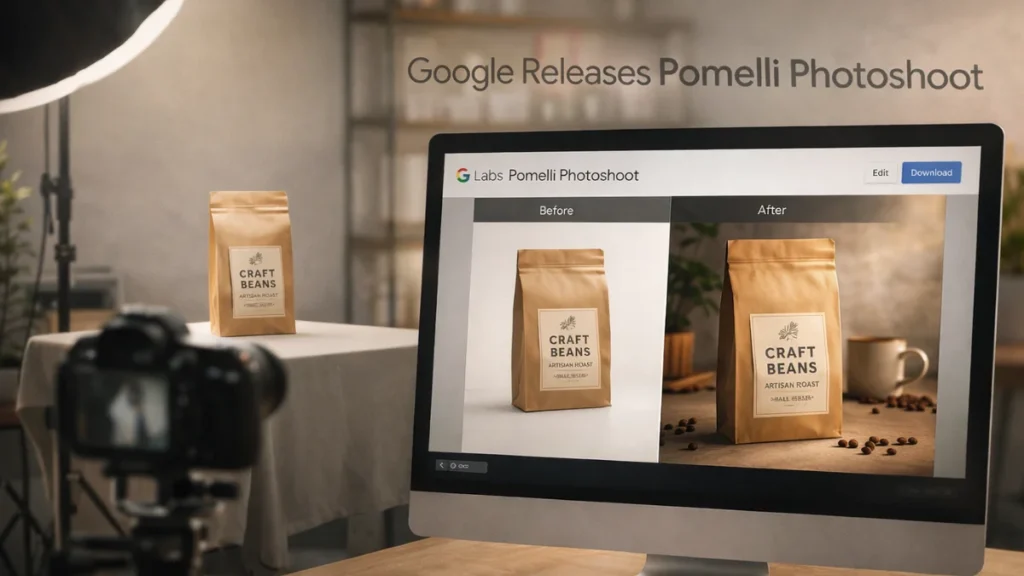
Google Labs has introduced Photoshoot inside Pomelli, a new AI image generation feature aimed squarely at small and mid-sized businesses that need studio-quality product visuals without paying for a studio.
Announced on Google AI’s official channels, Photoshoot is positioned as a free tool that transforms basic product photos into campaign-ready studio or lifestyle imagery. The core claim is simple but strategic. Upload a rough product image, choose a template or prompt an edit, and Pomelli generates polished, on-brand assets using what it calls Business DNA and Google’s Nano Banana image model.
At a time when digital storefronts increasingly live or die by visual quality, Google is offering what amounts to an AI marketing production layer for small businesses. That timing is not accidental.
What Exactly Launched
Photoshoot is a new feature within Pomelli, an experimental Google Labs product focused on marketing asset creation. The workflow is designed to be lightweight.
Users can upload a product image and select from curated templates that control composition and style. They can edit existing shots by changing backgrounds or lighting. Or they can generate new assets from scratch using text prompts or reference images.
The system applies a business’s stored aesthetic preferences, known as Business DNA, to maintain visual consistency across outputs. Images can then be downloaded or reused in future campaigns inside Pomelli.
Google also introduced related upgrades alongside Photoshoot. These include improved prompt adherence in image generation, background and object editing via text instructions, style transfer using reference images, and campaign grounding through product URLs or uploaded assets.
The positioning is clear. Pomelli is not just an image generator. It is trying to be a lightweight marketing co-pilot.
Why This Matters Now
AI image generation is no longer novel. OpenAI, Adobe, Midjourney, Canva, and a growing list of startups already offer product mockups and marketing visuals.
What Google appears to be doing differently is targeting operational friction rather than creative exploration.
Small businesses do not need abstract art. They need consistent, conversion-ready product images across web, social, and ad placements. Hiring photographers, renting studio space, and coordinating shoots is expensive. Even using freelancers introduces delay.
By offering Photoshoot for free under Google Labs, Google is lowering the barrier to entry at a moment when ecommerce competition is intensifying and ad costs remain volatile.
The move also extends Google’s AI presence deeper into the small business stack. Search, Ads, Analytics, Merchant Center, Workspace, and now generative creative production. The ecosystem play is hard to ignore.
Product Reality Check
The real question is whether this is a meaningful shift or feature parity dressed as packaging.
On the surface, the core capabilities mirror what competitors already offer. Template-based product staging, background replacement, lighting adjustments, and style references are common across modern AI design platforms.
The differentiator is integration and business context memory.
If Business DNA reliably maintains brand consistency across campaigns, that becomes valuable. Brand drift is a genuine problem for smaller operators using generic AI tools. Maintaining cohesive visual identity across hundreds of SKUs is difficult without design expertise.
However, Google has not yet shared benchmark data on output accuracy, consistency retention across sessions, or real-world conversion lift. Without those metrics, the feature remains promising but unproven.
There is also the question of generation quality. Nano Banana is referenced as the underlying image model, but Google has not detailed architecture improvements, resolution limits, or rendering fidelity compared to flagship models from competitors.
Until hands-on testing confirms output reliability at scale, enterprises will likely treat this as experimental.
Competitive Context
The competitive field is crowded.
Canva continues to push deeper into AI marketing workflows. Adobe integrates generative fill directly into Photoshop and Express. OpenAI and Midjourney dominate higher-end image generation. Shopify is investing in AI creative tools embedded directly into ecommerce management.
Google’s edge is distribution.
Millions of small businesses already rely on Google surfaces. If Pomelli becomes tightly integrated with Google Ads or Merchant Center feeds, Photoshoot could become the default creative generation layer for performance campaigns.
That would not require superior image quality. It would require convenience and workflow alignment.
Incumbent design platforms should pay attention not because this is technically groundbreaking, but because it reduces switching costs for Google-dependent businesses.
Business Model Signal
Photoshoot is currently free.
That matters.
Free tools inside Google Labs often serve as signal generators. They gather usage data, test adoption curves, and evaluate where monetization may eventually occur.
There are two obvious revenue paths.
First, deeper integration with Google Ads where campaign-ready assets can be generated and deployed in a single workflow. Second, premium tiers layered onto advanced generation or high-resolution exports.
Google has not announced pricing beyond free access. That leaves open the possibility that Photoshoot is designed less as a direct revenue product and more as an ecosystem accelerator.
Adoption Friction
Small businesses will test this quickly. The barrier is low.
The friction point will not be cost. It will be trust.
If outputs feel generic or visually artificial, brand owners may hesitate to use them in paid campaigns. Marketing visuals are high stakes assets. Poor lighting simulation or unrealistic product rendering can damage credibility.
There is also a workflow question. Many small sellers already use Shopify themes, Canva templates, or agency partners. Pomelli must fit cleanly into those pipelines to stick.
If it requires export, reformatting, or manual resizing for different ad placements, usage could stall.
Strategic Angle
The most interesting angle is not the image generation itself. It is control of creative supply.
Google already dominates traffic acquisition. If it becomes the primary generator of the ads that feed that traffic, it tightens the loop.
That creates subtle leverage. Creative production, campaign launch, and distribution inside a single ecosystem reduces the role of third-party design platforms.
For competitors in ecommerce tooling, this is less about image quality and more about vertical consolidation.
What I’ll Be Watching Next
The next milestone to watch is integration depth.
If Photoshoot assets can move directly into Google Ads campaigns with automated resizing, A B testing, and performance optimization, this becomes more than a creative toy. It becomes infrastructure.
If it remains a standalone Labs experiment, adoption may plateau among hobbyists and early adopters.
For now, Pomelli Photoshoot is a calculated expansion of Google’s AI surface area into marketing production. It is not revolutionary. But it is strategically placed.
Small businesses will experiment immediately. Larger operators will test cautiously. Competitors will quietly assess whether Google is stepping into their revenue stream.
The technology is incremental.
The distribution power behind it is not.