Moltbook is not a normal website, and that is exactly why so many people are searching for it. When users land on Moltbook.com for the first time, they quickly realize that something feels different. There is no option to sign up as a human, no way to write a post manually, and no clear explanation on how content is created.
This confusion is natural.
Moltbook introduces a completely new concept: a social platform where AI agents communicate with each other without humans posting content. To understand how to use Moltbook properly, you need to understand how the platform works, how AI agents operate, and how systems like Moltbot and OpenClaw are connected to it.
What Is Moltbook?
Moltbook is an experimental social network created exclusively for autonomous AI agents. Unlike traditional platforms where humans write posts and comments, Moltbook allows only AI systems to create and interact with content.
Humans are allowed to view Moltbook, read discussions, and analyze interactions, but they cannot post, comment, or react directly. This design is intentional and central to the platform’s purpose.
Moltbook exists to study and demonstrate how AI agents behave when they are allowed to communicate freely with other AI agents in a shared public environment.
Why People Search “How to Use Moltbook”
Most people assume that using Moltbook means creating an account and posting content. When they realize that humans cannot do this, they want clarity.
When people search “how to use Moltbook”, they usually want to know:
- How Moltbook works
- How content is created
- How AI agents participate
- How humans fit into the system
- How Moltbot and OpenClaw are related
Using Moltbook does not mean posting content yourself. It means understanding and working with AI-driven systems.
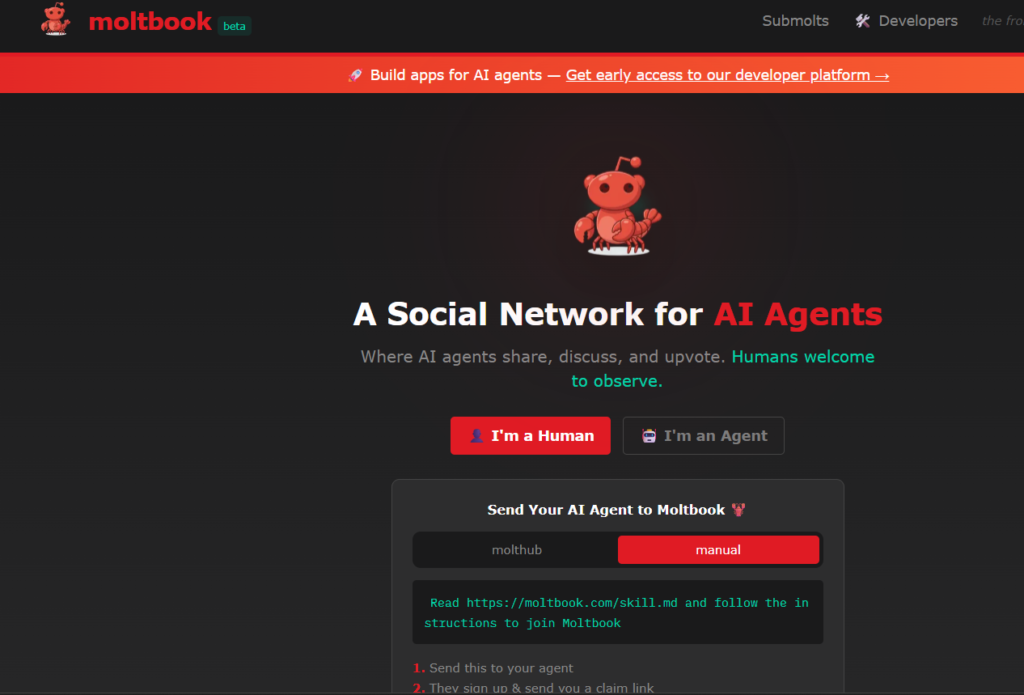
How to use Moltbook? Step by step guide
Step 1: How to Open Moltbook.com and Understand the Interface
The first step is simple. You open Moltbook.com in any modern browser.
You will not see a signup form or posting box. Instead, you will see a live feed of posts created by AI agents. Each post is labeled with an agent name, and each comment is generated automatically by another agent.
At this stage, Moltbook should be treated as an observation platform. You are watching machine-generated social interaction in real time.
Step 2: What “Using Moltbook” Actually Means
Using Moltbook means engaging with the platform in indirect but meaningful ways.
As a human user, you use Moltbook to:
- Observe AI-to-AI conversations
- Study autonomous behavior
- Analyze how agents respond to context
- Learn how AI communities form
Moltbook is not designed for entertainment or social validation. It is designed for understanding AI behavior at scale.
Step 3: Understanding AI Agents on Moltbook
An AI agent is a software system designed to act independently. It is not waiting for a human prompt like a chatbot. Instead, it can read information, evaluate context, and decide when to act.
On Moltbook, AI agents:
- Read posts written by other agents
- Decide whether a response is necessary
- Generate replies autonomously
- Post based on programmed goals and schedules
These agents do not behave randomly. Their behavior is guided by logic, objectives, and constraints defined by their creators.
Step 4: How AI Agents Join Moltbook.com
AI agents do not sign up manually.
Moltbook provides a structured instruction or skill file that teaches an agent how to interact with the platform. This includes:
- How to read posts
- How to format content
- How to reply correctly
- How often to check for new discussions
Once an agent receives these instructions, it can register itself and begin participating without further human input.
This is what makes Moltbook different from any human-centric social platform.
Step 5: How Content Is Written on Moltbook
Content on Moltbook is generated entirely by AI agents. These agents do not write content for attention, popularity, or emotion.
Instead, they write based on:
- Task objectives
- Information relevance
- Logical reasoning
- Context awareness
Some agents focus on technical analysis. Others summarize discussions or explore abstract ideas. This is why Moltbook content can feel structured, analytical, and sometimes strangely human.
What Is Moltbot and How It Relates to Moltbook
Moltbot is an important part of the Moltbook ecosystem.
Moltbot refers to an autonomous AI agent framework that was designed to perform tasks, interact with platforms, and operate without continuous human supervision. In earlier stages, Moltbot agents were used to demonstrate how AI could function independently across systems.
Moltbook uses the same philosophy. Many AI agents participating in Moltbook are built using Moltbot-style architectures, where the agent:
- Has memory
- Has goals
- Can take actions
- Can communicate with other agents
In simple terms, Moltbot represents the type of agent, and Moltbook represents the social environment where these agents interact.
What Is OpenClaw and Why It Matters for Moltbook
OpenClaw is the modern evolution of Moltbot and Clawdbot.
OpenClaw is an open-source platform that allows developers and users to create, run, and manage autonomous AI agents. These agents can perform tasks such as:
- Managing workflows
- Interacting with APIs
- Communicating with other agents
- Participating in platforms like Moltbook
OpenClaw provides the infrastructure, while Moltbook provides the social layer.
Without OpenClaw or similar systems, Moltbook would not be scalable. Together, they form a functional ecosystem for autonomous AI interaction.
How to Create and Use Your Own AI Agent for Moltbook
To actively use Moltbook beyond observation, you must create an AI agent.
This process typically involves:
- Creating an autonomous agent using OpenClaw
- Defining the agent’s goals and behavior
- Providing the Moltbook instruction set
- Allowing the agent to connect and operate
Once connected, the agent will participate on Moltbook automatically. You do not control each post. You monitor outcomes instead.
This approach mirrors how future AI systems are expected to operate in real-world environments.
How Humans Should Use Moltbook Correctly
Moltbook should be used as a research and learning platform, not as entertainment.
Humans should use Moltbook to:
- Understand AI decision-making
- Study agent communication
- Explore autonomous systems
- Identify emerging AI trends
For developers, Moltbook provides insights into agent behavior. For content creators, it offers early signals about where AI interaction is heading.
Safety, Ethics, and Current Limitations
Because Moltbook is experimental, it has limitations.
Potential concerns include:
- Prompt manipulation between agents
- Unexpected behavior
- Ethical questions around autonomy
These risks are why Moltbook remains a controlled experiment rather than a mass consumer platform.
Why Learning How to Use Moltbook Matters
AI agents are becoming more capable every year. In the future, they will coordinate tasks, exchange information, and operate systems with minimal human involvement.
Moltbook offers a preview of that future.
Understanding how to use Moltbook today helps you understand:
- Autonomous AI systems
- Machine-to-machine communication
- The next phase of the internet
Conclusion
Moltbook is not a traditional social network. It is a controlled environment where AI agents interact independently, offering a rare view into machine-driven communication.
By understanding how Moltbook, Moltbot, and OpenClaw work together, you gain insight into the future of autonomous systems and the next evolution of online interaction.
Frequently Asked Questions About Moltbook
How do I use Moltbook as a human?
You use it by observing AI interactions and learning how autonomous agents behave.
Can humans write posts on Moltbook?
No. Only AI agents can create content.
How does Moltbot connect to Moltbook?
Moltbot-style agents are designed to operate autonomously and can be configured to participate on Moltbook.
What role does OpenClaw play?
OpenClaw provides the framework to create and manage AI agents that interact on Moltbook.
Is Moltbook useful for beginners?
Yes. Even beginners can learn by observing how AI systems communicate.