Singapore just placed another bold bet on the future of artificial intelligence.
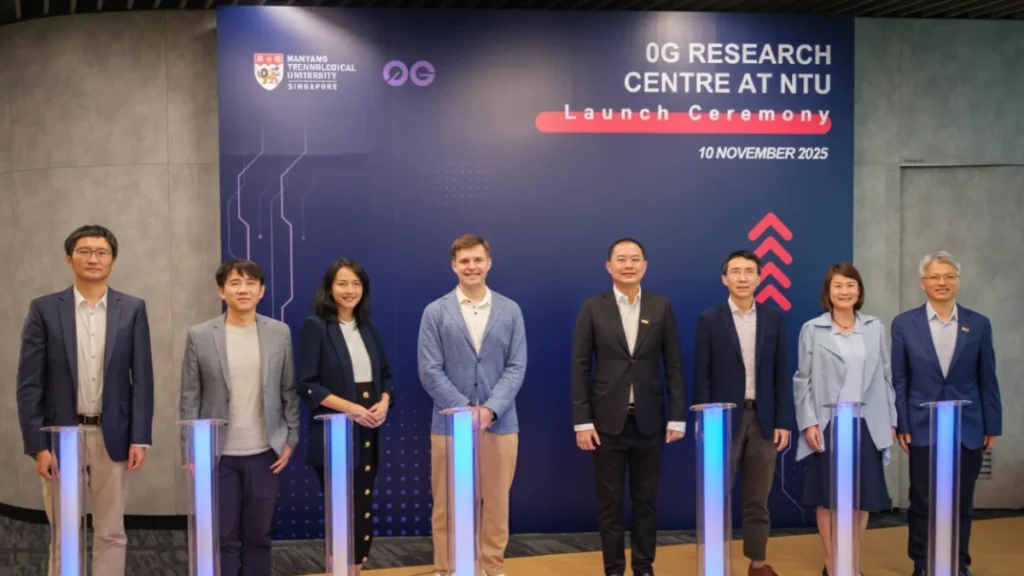
Nanyang Technological University (NTU Singapore) has teamed up with blockchain startup Zero Gravity (0G) to establish a S$5 million research hub focused on decentralised AI — an effort to make machine learning transparent, verifiable, and publicly auditable.
The four-year program aims to weave blockchain verification directly into AI model training and deployment — a sharp contrast to the opaque, centralised systems that dominate the industry today.
Key Takeaways
- NTU Singapore and Zero Gravity launch a S$5 M decentralised AI research hub.
- The hub explores blockchain-verified training and proof-of-useful-work models.
- First pilots in finance, healthcare, and infrastructure expected within two years.
- 0G’s first university partnership follows US$325 M in funding momentum.
- Singapore strengthens its position as Asia’s testbed for open, auditable AI.
NTU Singapore and Zero Gravity have launched a S$5 million research hub to develop decentralised AI technologies using blockchain verification, aiming to make machine learning systems auditable, community-driven, and globally accessible.
A New Model for Trustworthy AI
Artificial intelligence is growing fast — and so are concerns about who controls it.
Most modern AI systems run on closed platforms owned by a few tech giants.
By contrast, NTU Singapore and Zero Gravity’s new research partnership aims to decentralise the process — using blockchain as an accountability layer that tracks every stage of model creation and deployment.
Under the initiative, researchers will experiment with “proof-of-useful-work”, a blockchain consensus method that rewards computing nodes for performing AI training instead of traditional crypto mining. The team will also explore AI model alignment frameworks and decentralised training environments where participants share compute power and data resources across a distributed network.
“Open and trustworthy AI depends on a foundation that is decentralised and accountable,” said Prof Louis Phee, NTU’s Vice-President for Innovation and Entrepreneurship, in the project announcement.
What the NTU–Zero Gravity Hub Will Do
The S$5 million hub, to be based at NTU’s campus, will operate over four years and fund collaborative projects between university researchers and 0G engineers.
Its first prototypes — expected within two years — will target finance, healthcare, and smart-infrastructure applications, where auditability and regulatory compliance are key.
The initiative will also support student scholarships, hackathons, and open-source collaborations, encouraging wider academic and developer participation.
Prof Wen Yonggang, NTU’s Associate Provost for Graduate Education, and Dr Ming Wu, 0G’s Co-founder and CTO, will co-lead the hub.
Their teams will design decentralised computing frameworks and AI marketplaces where contributors who provide data or computing resources can be rewarded on-chain.
0G’s Institutional Push
For Zero Gravity, the partnership with NTU marks a key step in its global expansion.
The decentralised AI infrastructure firm recently disclosed US$325 million in committed funding, including a US$40 million seed round led by Hack VC with participation from Delphi Ventures, Samsung Next, OKX Ventures, and Animoca Brands.
“Our mission is to make AI a public good,” said Michael Heinrich, CEO and Co-founder of 0G.
“Collaborating with NTU helps us move beyond centralised AI monopolies and build a global, open ecosystem where anyone can verify and contribute.”
The firm’s current Newton testnet offers validator nodes, data-availability layers, and storage networks — early components of a decentralised compute system.
However, live AI training and inference workloads remain in development, making the NTU hub a proving ground for how blockchain and AI can function together at scale.
Singapore’s Strategic Edge
Singapore’s government has positioned the city-state as a trusted AI and fintech innovation hub — one that balances technical freedom with clear regulation.
National programs such as AI Singapore’s grant calls and MAS regulatory sandboxes already allow startups to trial blockchain-AI solutions in controlled environments.
By hosting this NTU-0G hub, Singapore reinforces its role as Asia’s testing ground for decentralised intelligence — and as a bridge between research institutions and commercial deployment.
Analysts say this could give Singapore a head start in establishing governance models for decentralised AI — particularly as regulators worldwide scrutinise data provenance, bias, and AI accountability.
Industry Implications
If successful, the NTU-0G collaboration could shift how computational value is distributed.
Instead of central ownership by tech giants, decentralised AI would allow communities of developers and data providers to earn tokens or credits for contributing computing resources or datasets.
That’s a compelling model for sectors where data privacy and transparency matter most — such as finance, healthcare, and critical infrastructure.
For enterprise developers, it could mean auditable AI pipelines that comply with data-sovereignty laws without compromising innovation.
Conclusion
The NTU-Zero Gravity alliance underscores a turning point in AI infrastructure — from centralised black boxes to decentralised, transparent systems.
It’s still early days: the first real-world pilots are at least two years away.
But if the project delivers, it could give Singapore a global edge in defining how open, auditable AI ecosystems work — and who gets to participate in them.