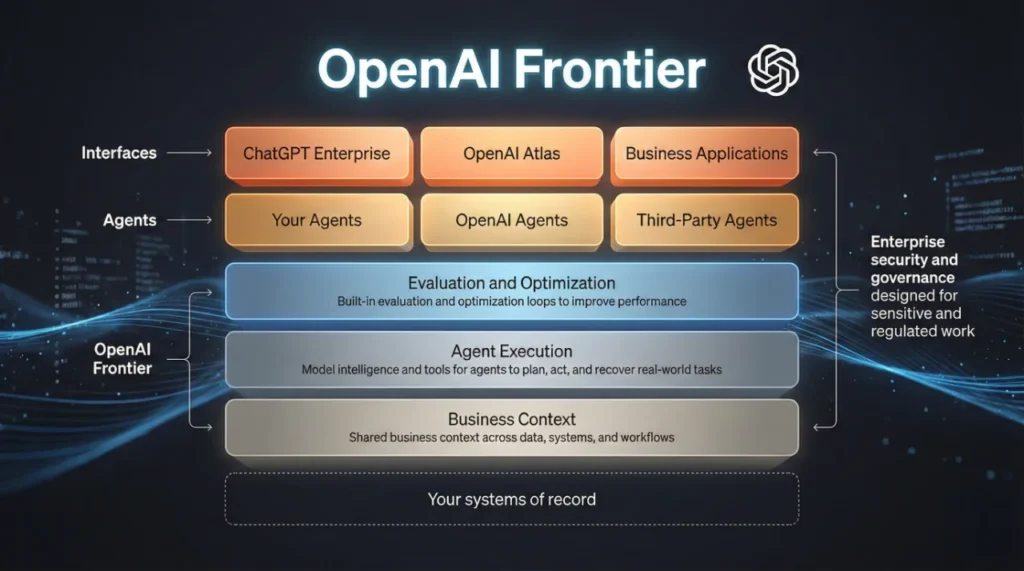
OpenAI is making a decisive push into enterprise infrastructure with Frontier, a new platform designed to help large organizations build, deploy, and manage AI agents that actually do work—not just demos.
The announcement signals a shift in how OpenAI wants businesses to think about AI. Instead of standalone tools or experimental pilots, Frontier frames AI agents as long-term coworkers: systems that understand company context, operate across internal tools, and improve through feedback over time.
For enterprises struggling to move AI beyond proofs of concept, OpenAI is pitching Frontier as the missing layer between powerful models and real-world execution.
Why OpenAI Thinks Enterprises Are Stuck
Despite rapid advances in AI capability, many companies remain bottlenecked by fragmentation. Data lives in disconnected systems. Permissions are complex. Each AI agent often operates in isolation, limiting its usefulness and increasing governance risk.
According to OpenAI, the problem isn’t intelligence—it’s deployment. As models evolve at breakneck speed, organizations are finding it difficult to scale AI responsibly without adding operational chaos.
Frontier is designed to close that gap by giving AI agents the same foundations humans rely on at work: shared context, access to tools, clear boundaries, and measurable performance standards.
What Frontier Actually Does
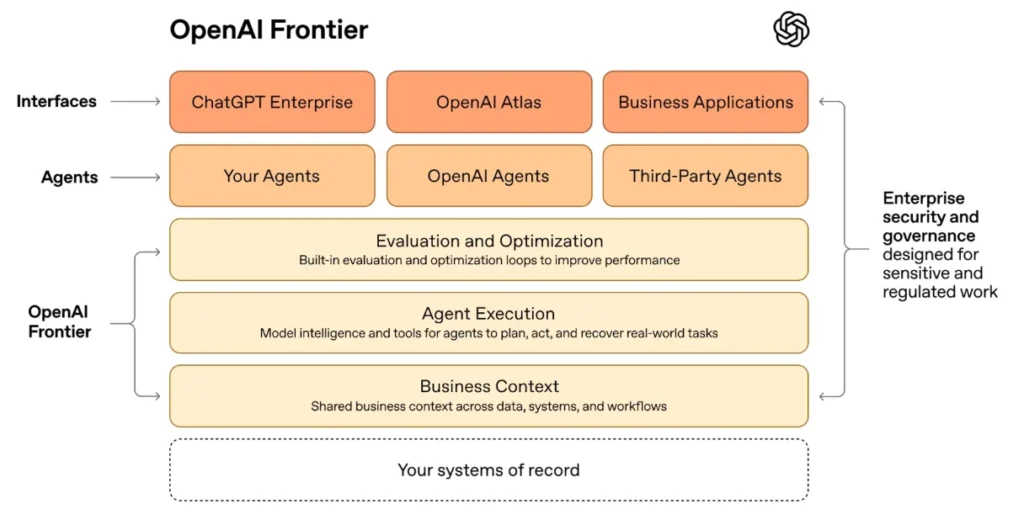
At a technical level, Frontier acts as a connective layer across enterprise systems. It links data warehouses, CRMs, internal apps, and cloud environments so AI agents can reason across workflows instead of operating in silos.
These agents can:
- Interact with files and internal tools
- Run code and complete multi-step tasks
- Retain memory from past interactions
- Operate through existing interfaces, not new dashboards
Crucially, Frontier doesn’t require companies to rebuild their infrastructure. It integrates with existing systems using open standards, allowing businesses to bring their current data and agents along.
Early Signals From Big Enterprises
Several large organizations are already piloting Frontier, including HP, Oracle, State Farm, Thermo Fisher Scientific, and Uber. OpenAI says existing customers like BBVA, Cisco, and T-Mobile are testing the platform on complex, high-value workflows.
In one example shared by the company, AI agents helped reduce engineering troubleshooting tasks from hours to minutes by automatically correlating logs, documentation, and code. In another, agents reclaimed significant time for sales teams by handling end-to-end operational tasks.
The common thread: Frontier is being positioned less as a chatbot layer and more as operational infrastructure.
Governance Becomes the Differentiator
One of Frontier’s most notable aspects is its emphasis on control.
Each AI agent is assigned a distinct identity with explicit permissions and guardrails. That makes it possible to audit actions, restrict access, and deploy agents in regulated environments—an area where many enterprise AI initiatives stall.
For companies in finance, healthcare, energy, and insurance, that governance-first approach may be the deciding factor.
An Open Ecosystem, Not a Walled Garden
OpenAI is also opening Frontier to third-party developers. AI-native startups are already building agents that plug into the same shared business context, reducing the need for one-off integrations.
The idea is to create an ecosystem where enterprise AI apps work better together because they draw from the same semantic understanding of how a business operates.
It’s a move that positions OpenAI not just as a model provider, but as a platform company competing for a central role in enterprise workflows.
What Happens Next
Frontier is currently available to a limited set of customers, with broader access expected in the coming months. OpenAI is pairing deployments with its Forward Deployed Engineers—teams that work directly with enterprises to operationalize AI systems in production.
The broader bet is clear: as AI becomes table stakes, execution—not model quality—will separate leaders from laggards.
Conclusion
With Frontier, OpenAI is aiming to redefine how enterprises scale AI—moving from scattered agents to coordinated digital coworkers. If it works, Frontier could become a foundational layer for how large organizations actually use AI at work.