The launch of the Codex app for macOS marks a quiet but meaningful shift in how software development is organized and executed. Instead of treating AI as a single assistant inside an editor, Codex reframes it as a coordinated workforce—one that can be supervised, redirected, and trusted with long-running tasks.
For developers and teams already leaning on AI, this is less about novelty and more about control at scale.
A Turning Point for AI-Driven Development
Since the debut of Codex in 2025, developers have steadily pushed AI agents beyond quick snippets and refactors. What began as code generation has evolved into multi-hour and multi-day projects where agents design features, implement them, test their own work, and iterate.
That evolution exposed a bottleneck. Traditional tools—IDEs, terminals, and chat windows—were never designed to manage parallel AI workers. They assume a single human author moving step by step. Codex’s new desktop app exists to solve that mismatch.
The result is less like a smarter text box and more like an operations console.
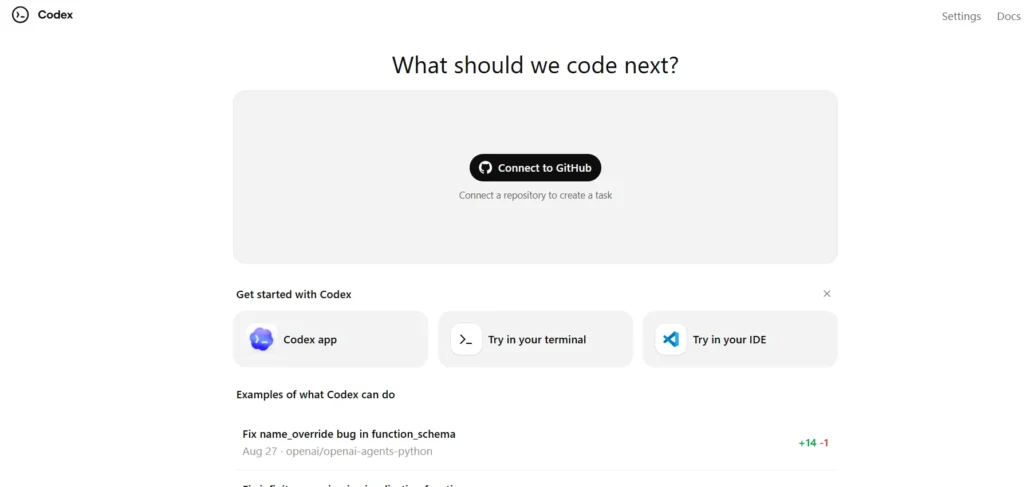
From Assistant to Command Center
The Codex app introduces a dedicated environment where multiple agents run simultaneously, each in its own thread and project context. Developers can switch between tasks without losing history, review changes as diffs, comment inline, or pull work directly into their editor for manual edits.
Under the hood, features like built-in Git worktrees allow several agents to work on the same repository without stepping on each other. Each agent operates in isolation, letting teams explore different approaches in parallel before deciding what to merge.
For experienced engineers, this mirrors how senior developers already think: parallel experimentation, delayed commitment, and tight review loops—now applied to AI collaborators.
Why “Skills” Matter More Than Code Generation
One of the most significant changes is Codex’s move beyond writing code to using code to get work done. Through configurable “skills,” Codex can connect instructions, scripts, and external tools into repeatable workflows.
That means an agent can fetch design assets from Figma, translate them into production-ready UI, deploy a build to a cloud platform, update a project tracker, and generate documentation—without being hand-held at every step.
Internally, teams at OpenAI have already been using hundreds of these skills to automate tasks that are tedious but critical: triaging bugs, summarizing failed builds, drafting reports, and monitoring experiments. The app now exposes that same capability to external developers.
What stands out to industry observers is not the individual tasks, but the consistency. Skills reduce ambiguity—one of the biggest failure points when delegating complex work to AI.
The Signal Behind the Racing Game Demo
OpenAI’s demonstration of Codex building a full 3D racing game with millions of tokens and extended self-testing is not about games. It’s a stress test.
The real takeaway is that Codex can maintain coherence across massive scopes of work, revisit earlier decisions, identify gaps by “playing” its own output, and fix issues without constant supervision. That kind of persistence is what separates experimental AI from something teams can rely on for production workflows.
To professionals watching closely, this suggests Codex is being positioned less as a coding novelty and more as infrastructure.
Automation Without Losing Oversight
Another subtle but important addition is Automations. These allow Codex to run tasks on a schedule—daily issue triage, release summaries, or system checks—while still routing results through a human review queue.
This design choice matters. It acknowledges a core tension in enterprise AI adoption: automation is valuable, but unchecked autonomy is risky. Codex’s model keeps humans firmly in the loop, without forcing them to micromanage.
Security controls reinforce that stance. Agents operate in sandboxed environments, request permission for elevated actions, and can be governed by team-level rules. For organizations wary of AI touching production systems, this is table stakes.
Why This News Matters
For individual developers, Codex lowers the cognitive load of juggling multiple complex tasks at once. Instead of serial work, engineers can supervise parallel progress and focus on judgment calls rather than keystrokes.
For teams, especially startups and mid-size companies, this could compress development cycles without ballooning headcount. A small group of engineers can now coordinate multiple AI agents across design, implementation, testing, and deployment.
For the broader industry, Codex signals a shift in how “developer productivity” is defined. The value is no longer just faster typing—it’s orchestration, supervision, and leverage.
What Comes Next
Over the next 6 to 24 months, expect several knock-on effects:
- Tooling pressure: IDEs and developer platforms will need to adapt to multi-agent workflows or risk becoming secondary interfaces.
- Team structures: Junior and senior roles may blur as AI takes on execution, pushing humans toward review, architecture, and product judgment.
- Enterprise adoption: With stronger security and automation controls, resistance from regulated industries is likely to soften.
There are risks. Over-reliance on agents without sufficient review could introduce subtle bugs or design debt. And teams will need new norms for accountability when “the agent did it” is no longer a hypothetical.
Still, the direction is clear. The Codex app is not just another AI feature—it’s a glimpse of a development environment where humans manage systems of intelligence rather than write every line themselves.
That’s a change the software industry has been inching toward for years. Now it has a tool built explicitly for it.