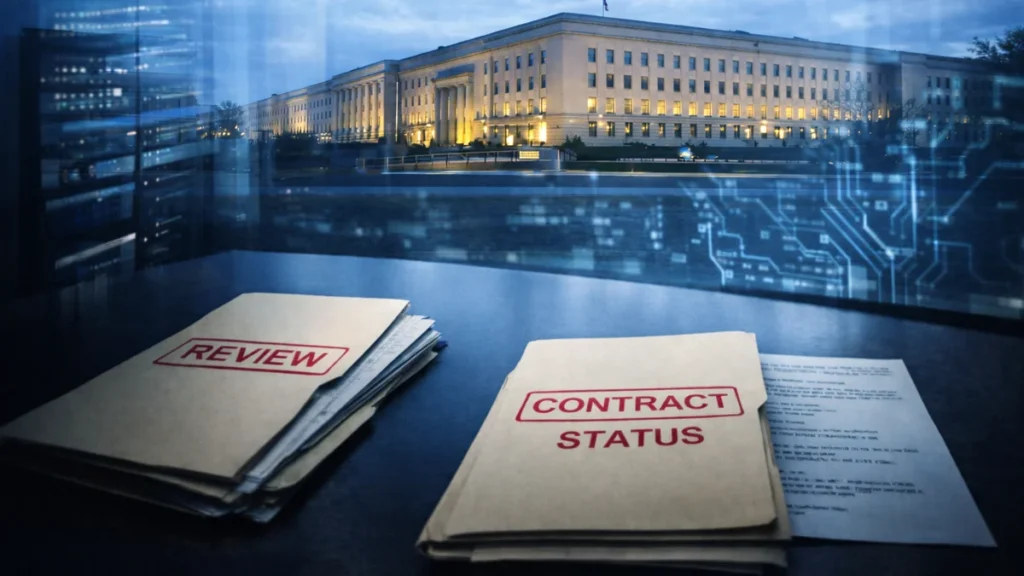
The Pentagon’s standoff with Anthropic is no longer a contract dispute. It is rapidly becoming a test of who sets the rules for how artificial intelligence is used inside the U.S. military — and how far civilian oversight extends once models enter classified systems.
If Defense Secretary Pete Hegseth follows through on threats to label Anthropic a “supply chain risk,” the move would ripple far beyond a single $200 million contract. It would signal that Washington is prepared to use procurement leverage to discipline AI companies that resist broad military usage terms — a pressure tactic usually reserved for foreign adversaries.
The Leverage Play Emerging Inside the Pentagon
At the center of the clash is Anthropic’s model, Claude. It is currently the only AI system deployed within classified Pentagon networks, according to people familiar with the matter. Defense officials privately praise its performance and reliability. Claude was reportedly used in operational planning earlier this year.
Yet negotiations over usage terms have grown contentious. The Pentagon wants the authority to deploy frontier AI models for “all lawful purposes.” Anthropic, led by CEO Dario Amodei, has pushed for guardrails limiting use in domestic mass surveillance and fully autonomous weapons.
That disagreement has escalated into a potential designation that would force contractors working with the Defense Department to certify they are not using Claude in their own workflows. Given Anthropic’s broad enterprise footprint — the company has said eight of the ten largest U.S. corporations use Claude — disentanglement would be disruptive.
This is not just about one vendor. It is about whether the Defense Department can impose a universal standard across the AI sector.
A Broader Contest Over Infrastructure Control
The U.S. military increasingly views advanced AI models as infrastructure — akin to cloud computing or secure networking. Once embedded, they become operational dependencies.
Anthropic’s presence in classified systems gives it unusual leverage. Replacing a model inside sensitive environments is not like swapping out SaaS software. It requires revalidation, retraining, compliance checks, and operational testing. Even senior administration officials acknowledge competing models are “just behind” in certain specialized government applications.
That dependency complicates the Pentagon’s hardball strategy. A designation meant to punish could also delay deployments or create integration friction across contractors and agencies.
At the same time, allowing one AI lab to dictate operational constraints inside military systems presents its own strategic concern. From the Pentagon’s perspective, civilian companies should not unilaterally narrow lawful military authority. Especially not in domains tied to intelligence gathering or battlefield decision support.
This is infrastructure control disguised as policy disagreement.
The Surveillance Question Few Want to Formalize
The underlying tension revolves around scale.
The Defense Department already collects publicly available information — social media posts, public records, open-source intelligence. That authority predates AI. What changes with large language models is throughput.
AI can process volumes of public data that would overwhelm human analysts. Anthropic officials argue that mass analysis of civilian speech at scale, even if technically lawful under current statutes, raises civil liberties risks that Congress has not explicitly addressed.
Existing surveillance law did not anticipate models capable of continuously monitoring, cross-referencing, and flagging behavioral patterns across millions of Americans.
The Pentagon’s counterargument is procedural: if it is lawful, it should not be contractually restricted by private companies. Officials insist that operational gray areas make rigid limitations unworkable.
This is less a philosophical debate than a governance vacuum. Congress has not meaningfully updated surveillance frameworks to account for frontier AI capabilities. In that vacuum, procurement contracts are becoming the battleground.
The Competitive Signal to OpenAI, Google and xAI
Anthropic is not negotiating alone. The Pentagon is simultaneously engaging with OpenAI, Google and xAI over similar usage standards.
Those companies have reportedly loosened safeguards for military use in unclassified environments. Classified systems remain a more sensitive threshold.
By escalating publicly with Anthropic, defense officials may be sending a message to the broader field: resistance will carry consequences.
If Anthropic is formally labeled a supply chain risk, it establishes precedent. It tells other AI labs that participation in national security work may require alignment with a broad “all lawful use” doctrine — even where law has not caught up with capability.
The Pentagon appears confident competitors will ultimately agree. But sources familiar with the talks suggest details remain unsettled.
The outcome could determine whether AI labs collectively shape military norms — or whether the military standardizes terms across the industry.
The Financial Stakes Are Secondary — For Now
Financially, the threatened $200 million contract is small relative to Anthropic’s reported annual revenue of roughly $14 billion.
The real exposure lies elsewhere.
If contractors must certify they do not use Claude in any workflow tied to defense business, that could create compliance headaches across Fortune 500 enterprises with defense exposure. The cost would not simply be lost revenue; it would be reputational and operational friction across Anthropic’s enterprise base.
For the Pentagon, the risk is strategic timing. Frontier AI capabilities are moving quickly. Delays in deployment, retraining, or vendor switching could slow modernization initiatives the department has publicly prioritized.
Neither side benefits from a prolonged rupture.
Where This Leaves the AI Power Balance
The dispute surfaces a deeper reality: frontier AI labs now sit at a crossroads between commercial markets and sovereign power.
They rely on government contracts, but also court enterprise clients concerned about privacy, compliance and brand risk. Military partnerships enhance credibility and funding stability. Civil liberties controversies carry political and market consequences.
Anthropic’s identity has been built in part on safety positioning. The Pentagon’s approach suggests safety frameworks may need to bend when national security is invoked.
If the Defense Department ultimately compels alignment — either through pressure or by shifting to competitors — the episode will recalibrate how much influence AI founders retain once their systems enter federal infrastructure.
If, instead, Anthropic negotiates guardrails that become standard across the industry, it could establish a template for AI deployment inside democratic institutions.
For now, the confrontation underscores a reality Washington is only beginning to confront: advanced AI is not merely software procurement. It is governance by contract — and the terms of that governance are still being written.